


Introduction
Compliance has become one of the biggest hidden bottlenecks for modern SaaS companies.
Not because frameworks like SOC 2, ISO 27001, or GDPR are difficult to understand—but because executing compliance consistently at scale is complex, manual, and fragmented.
Today, compliance directly impacts:
- Your ability to close enterprise deals
- Customer trust and brand credibility
- Operational and security risk
- Investor confidence
Yet, many organizations still rely on spreadsheets, shared folders, and disconnected workflows to manage compliance.
According to industry data, organizations spend up to 40–50% of their time on manual audit preparation, while more than 60% struggle with real-time visibility into compliance status.
This is exactly the gap SureComply is designed to solve.
What is SureComply?
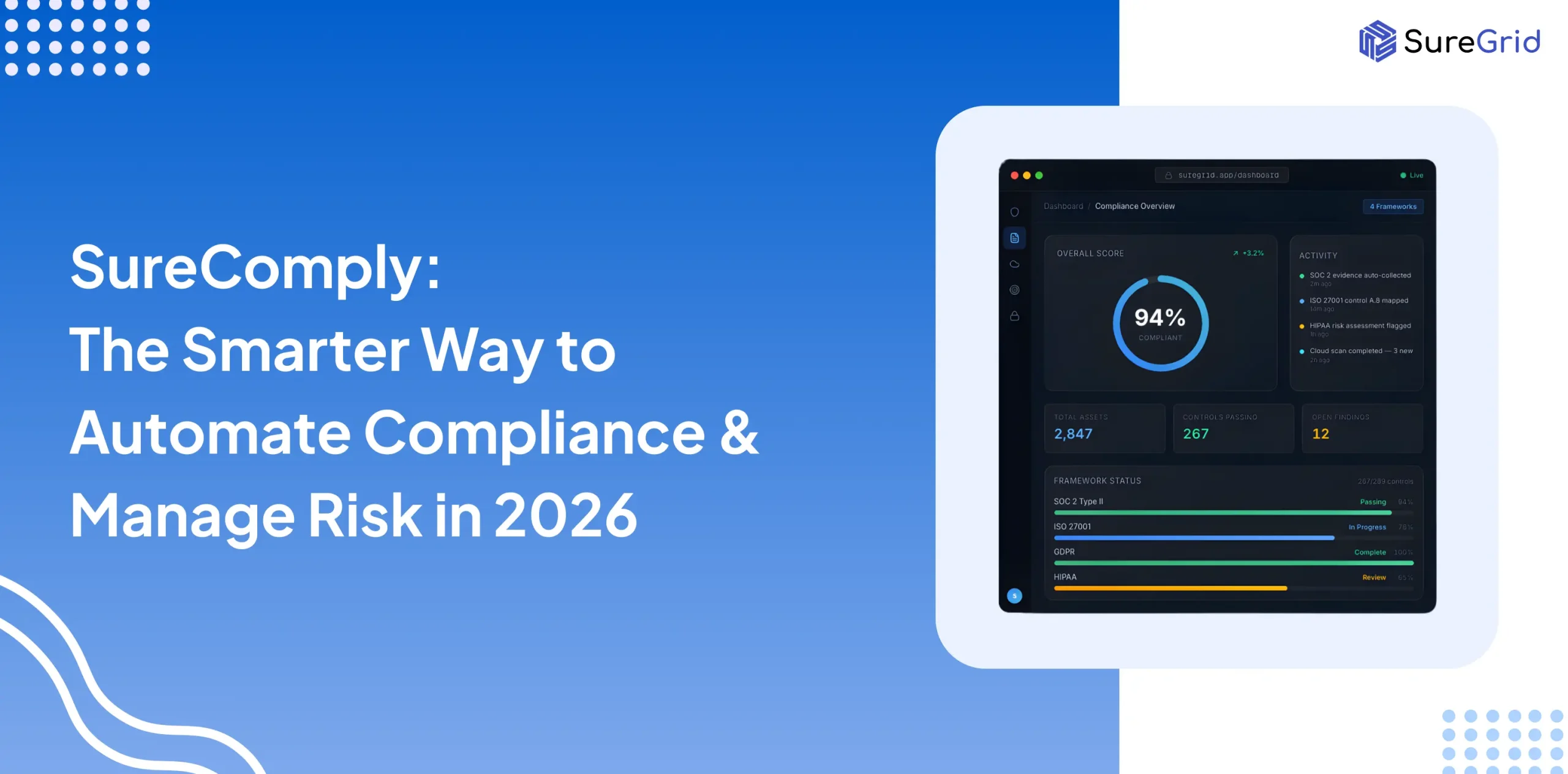
SureComply is an automated compliance and risk foundation built for modern, cloud-native businesses.
Instead of treating compliance as a checklist, it transforms it into a structured, continuous, and risk-aware system.
With SureComply, organizations can:
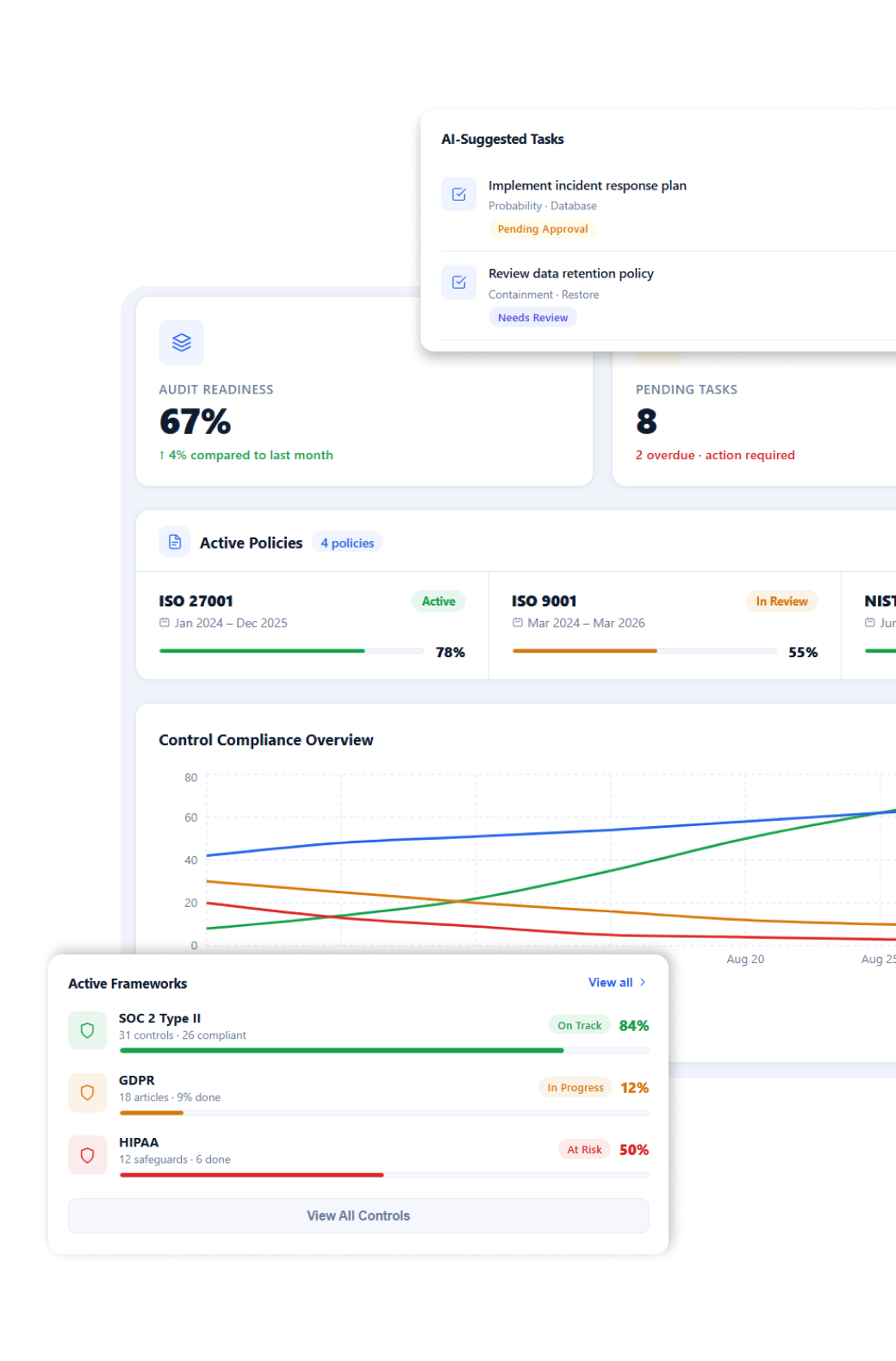
- Manage compliance at the control level
- Detect gaps continuously—not just during audits
- Map risks directly to compliance issues
- Stay audit-ready at all times
In simple terms, SureComply replaces manual, fragmented compliance processes with a centralized, intelligent system.
Why Traditional Compliance Breaks?
From real-world experience working with SaaS and fintech companies, one thing is clear:
Compliance doesn’t fail because requirements are unclear.
It fails because execution lacks structure.
Here are the most common breakdown points:
Surface-Level Tracking
Most teams track compliance at a framework level (“SOC 2 done”) instead of tracking individual controls, which is what auditors actually evaluate.
Manual Interpretation
Different stakeholders interpret control requirements differently, leading to inconsistencies and audit risks.
Late Gap Discovery
Compliance gaps are often discovered during audits or customer reviews—when it’s already too late.
Risk Disconnected from Compliance
Risk is either tracked separately or not at all, leading to poor prioritization.
Heavy Manual Effort
Evidence collection, policy mapping, and task tracking are all done manually.
The result is:
- Repeated effort
- Poor visibility
- Unpredictable audit outcomes
SureComply addresses these challenges by introducing structure, automation, and continuous visibility.
Why Compliance is the Best Entry Point for GRC
A critical insight often overlooked:
Compliance is unavoidable.
- Enterprise customers require it before closing deals
- Audits enforce it regularly
- Budgets are already allocated
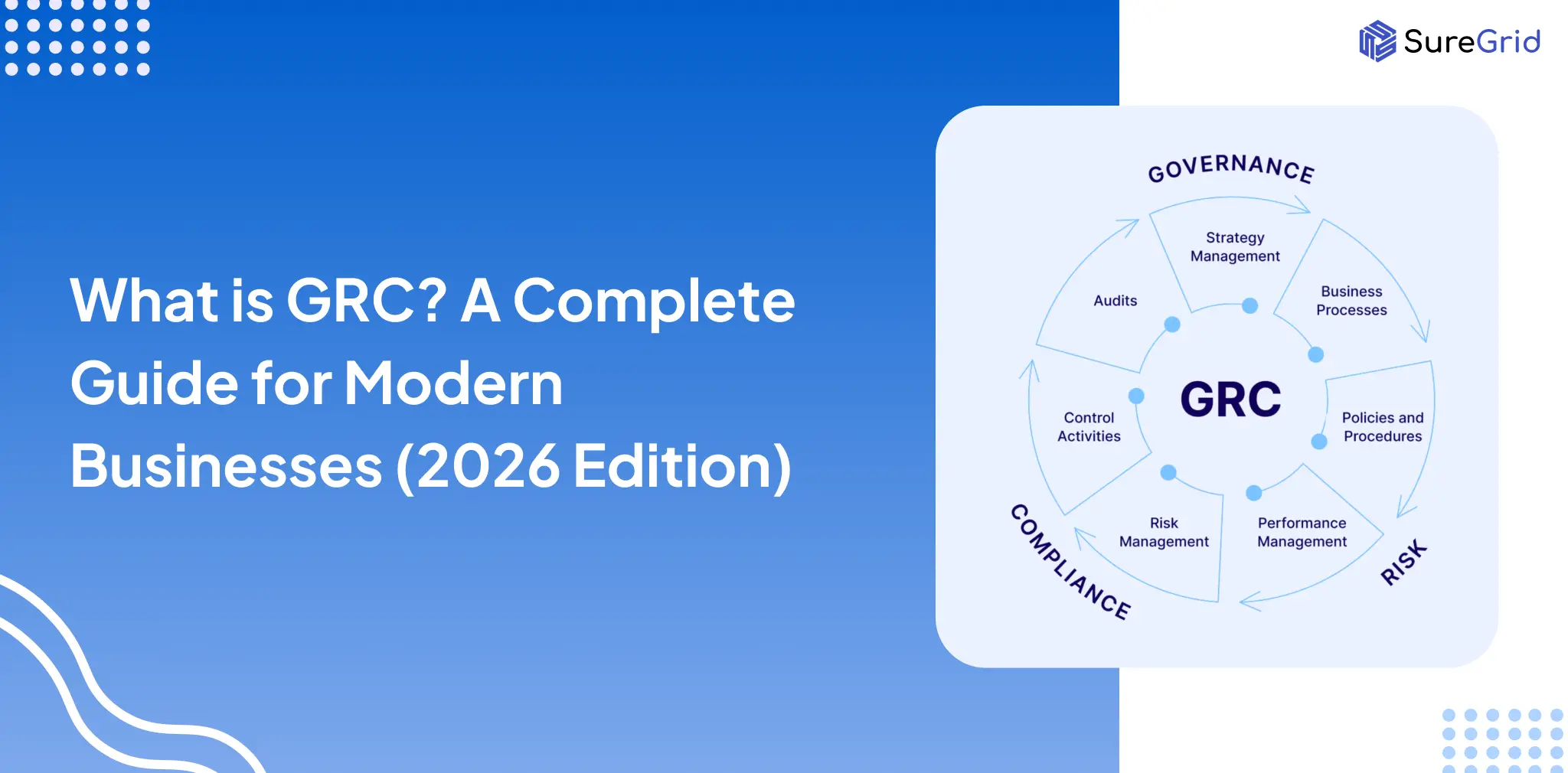
This makes compliance the most natural and low-friction entry point into governance, risk, and compliance (GRC).
More importantly, compliance data becomes the foundation for broader risk and security decisions.
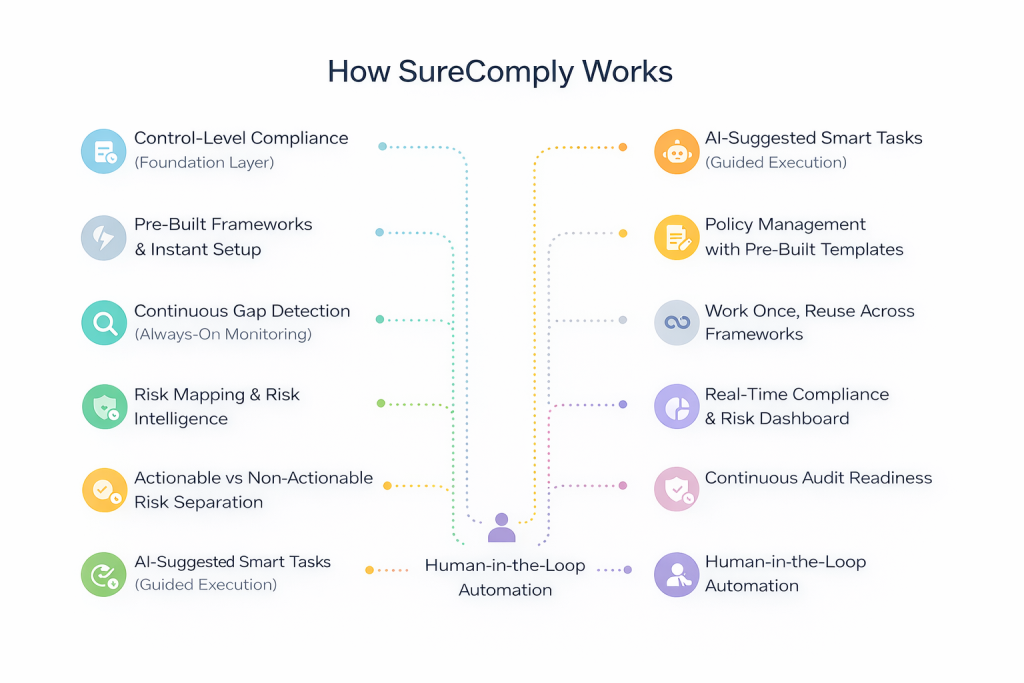
How SureComply Works?
1. Control-Level Compliance
SureComply breaks frameworks into individual controls, making them the core unit of work.
- One control can support multiple frameworks
- Work is done once and reused across requirements
This aligns directly with how auditors evaluate compliance, making audits smoother and more predictable.
2. Continuous Gap Detection
Instead of waiting for audits, SureComply continuously identifies:
- Missing controls
- Missing ownership
- Missing policies
- Incomplete implementations
This allows teams to detect and fix issues early, shifting compliance from reactive to proactive.
3. Risk is Built into Compliance
Unlike traditional tools, SureComply treats risk as an outcome of compliance gaps and context.
It identifies multiple types of risks:
- Gap-Based Risks: Missing or incomplete controls
- Context-Based Risks: Controls exist but are insufficient for specific use cases
- Configuration Risks: Framework setup is incomplete
- Lifecycle Risks: Reviews are missed or evidence is outdated
This ensures that compliance reflects real operational risk, not just audit readiness.
4. Actionable vs Non-Actionable Risk
One of the most practical innovations in SureComply is the separation of:
Actionable Risks
- Can be resolved immediately
- Generate clear, guided tasks
Non-Actionable Risks
- Require awareness or business decisions
- Do not create unnecessary tasks
This reduces noise and helps teams focus on what truly matters.
5. Pre-Built Policy Templates
SureComply provides:
- Framework-aligned templates
- Policies mapped directly to controls
- Easy customization before approval
This eliminates the need to start from scratch and significantly reduces preparation time.
6. AI-Suggested Smart Tasks
Tasks are generated only when necessary and clearly explain:
- What needs to be done
- Which control it impacts
- Why it matters
Automation supports decision-making without taking control away from users.
Real Business Impact
Organizations adopting structured compliance systems like SureComply typically experience:
- 40–60% reduction in audit preparation time
- Improved visibility into compliance gaps
- Faster enterprise deal closures
- Reduced risk exposure through early detection
From practical experience, the biggest impact is not just efficiency—it’s confidence.
Teams gain clarity on:
- What is missing
- Why it matters
- What should be prioritized
Who Should Use SureComply?
SureComply is designed for modern SaaS companies that:
- Have 50–500 employees
- Sell to enterprise or regulated customers
- Use cloud platforms like AWS, Azure, or GCP
- Are preparing for SOC 2, ISO 27001, or GDPR
- Currently manage compliance manually
This segment benefits the most because compliance pressure is high, and manual systems quickly become unsustainable.
What Success Looks Like in 30 Days?
Within the first month of using SureComply, organizations typically achieve:
- Enabled compliance frameworks
- Automatically mapped controls
- Clear visibility into compliance gaps
- Risks linked to affected controls
- Policy templates implemented
- Tasks assigned and tracked
- A real-time compliance dashboard
The outcome is a shift from uncertainty to clarity.
Why SureComply Becomes a System of Record?
Once implemented, SureComply becomes central to compliance operations because:
- Compliance and risk are unified
- Data is continuously updated
- Teams rely on dashboards for decision-making
- Audits depend on structured outputs
Switching away would mean returning to fragmented and manual workflows.
Expansion into Full GRC
Once compliance is structured, organizations naturally expand into broader capabilities within SureGrid, including:
- SurePilot for automating security questionnaires
- SureCloud for cloud risk monitoring
- SureHunt for continuous security validation
This creates a unified ecosystem for governance, risk, and compliance.
Conclusion
Compliance should not be:
- Manual
- Reactive
- Fragmented
It should be:
- Structured
- Continuous
- Risk-aware
That’s exactly what SureComply delivers.
It doesn’t just help organizations pass audits—it helps them build a clear, reliable, and scalable compliance and risk foundation.