

AI Penetration Testing Proof, not promises.
Traditional pentests tell you what might be wrong. SureHunt shows what can actually be exploited right now. Continuously simulate real attacker behavior, validate exploit paths, and get clear, prioritized fixes — not reports.
Security issues don’t cause breaches. Exploitable paths do.
- Vulnerabilities are identified but not validated
- Issues are analyzed in isolation
- Testing is periodic and quickly outdated
- Teams lack clarity on which risks matter most

High volume of findings with limited prioritization
Security tools produce extensive lists of issues, but provide limited guidance on what requires immediate attention.
Assessments that do not reflect current risk
Periodic testing fails to keep pace with frequent application changes, leaving gaps in coverage.
Limited visibility into real attack scenarios
Without connecting related weaknesses, teams cannot clearly understand how breaches can occur.
A structured approach to identifying real security risk

Continuous security validation aligned with change
Testing adapts to application updates, ensuring risks are identified as environments evolve.
Accurate visibility into exposed assets
Provides a clear view of accessible endpoints, APIs, and application surfaces.

Contextual analysis of vulnerabilities
Evaluates issues within real-world scenarios to determine their practical impact.

End-to-end attack path visibility
Illustrates how multiple weaknesses can be combined into a complete breach scenario.

Validated the exploitability of identified risks
Confirms whether vulnerabilities can be exploited, reducing false positives

Risk-based prioritization for remediation
Focuses efforts on issues with the highest impact and likelihood of exploitation.
Continuous security validation aligned with change
Testing adapts to application updates, ensuring risks are identified as environments evolve.
Accurate visibility into exposed assets
Provides a clear view of accessible endpoints, APIs, and application surfaces.
Contextual analysis of vulnerabilities
Evaluates issues within real-world scenarios to determine their practical impact.
End-to-end attack path visibility
Illustrates how multiple weaknesses can be combined into a complete breach scenario.
Validated the exploitability of identified risks
Confirms whether vulnerabilities can be exploited, reducing false positives
Risk-based prioritization for remediation
Focuses efforts on issues with the highest impact and likelihood of exploitation.
See how attackers think. Fix what actually matters.
Continuous AI Pentesting
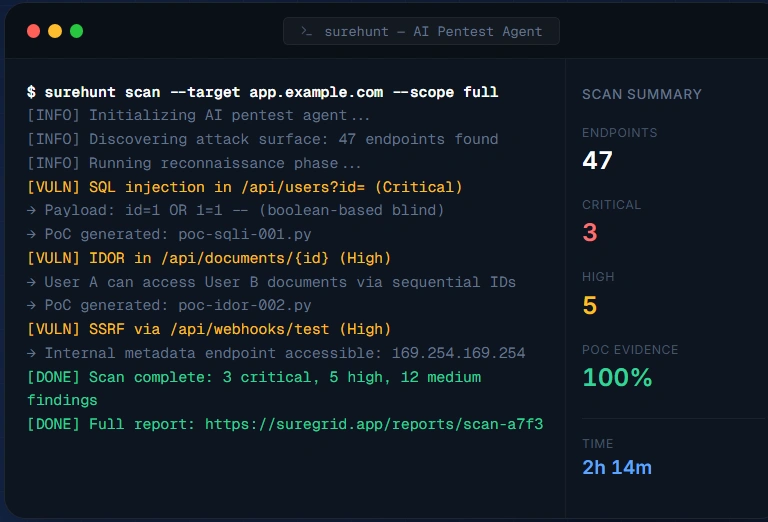
Autonomous agents continuously simulate real-world attacks across applications and APIs.
Dynamic Attack Surface Discovery
Automatically discover APIs, endpoints, subdomains, and hidden attack surfaces.
Validated Attack Graphs
Visualize how vulnerabilities chain together into real attack paths.
Safe Proof-of-Exploit Validation
Every finding includes non-destructive proof — validated safely in production or staging.
Risk-Based Prioritization
Get a single queue of what actually matters, based on exploitability and impact.
CI/CD & Workflow Integration
Trigger pentests on deploy and push findings directly into engineering workflows.
Continuous AI Pentesting
Autonomous agents continuously simulate real-world attacks across applications and APIs.
Dynamic Attack Surface Discovery
Automatically discover APIs, endpoints, subdomains, and hidden attack surfaces.
Validated Attack Graphs
Visualize how vulnerabilities chain together into real attack paths.
Safe Proof-of-Exploit Validation
Every finding includes non-destructive proof — validated safely in production or staging.
Risk-Based Prioritization
Get a single queue of what actually matters, based on exploitability and impact.
CI/CD & Workflow Integration
Trigger pentests on deploy and push findings directly into engineering workflows.
From attack simulation to continuous protection
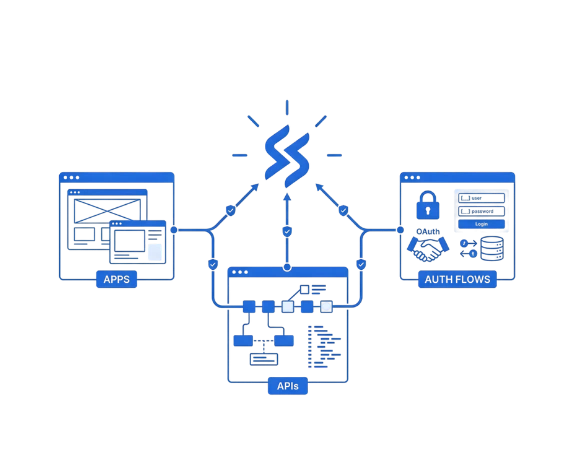
Step 1 – Connect your applications


Connect your applications, APIs, and authentication flows securely
SureHunt connects to your web applications, API specifications, and authentication methods to understand how your system is accessed. This builds a complete view of your attack surface from the start.
Step 2 – Discover your attack surface
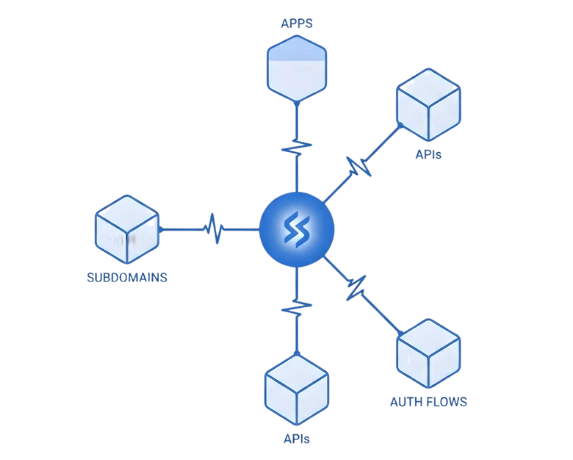
SureHunt continuously discovers and maps your entire attack
SureHunt continuously maps your environment like a real attacker, uncovering exposed and hidden entry points so you know exactly where attacks can begin.
Step 3 – Run continuous pentests
SureHunt runs continuous
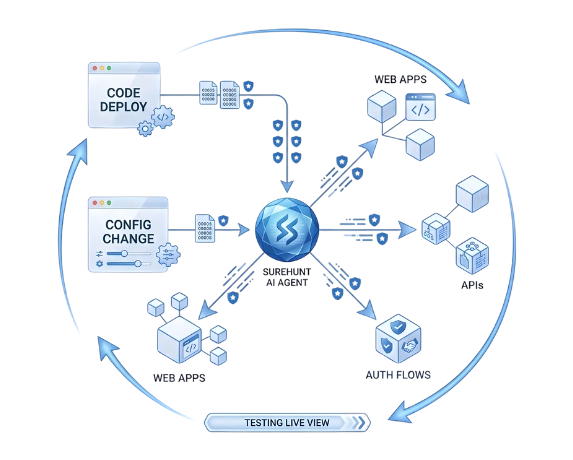
AI agents continuously test your applications across deployments, configuration changes, and new exposures, ensuring security is always up to date.
Step 4 – Identify and prioritize real risks
SureHunt identifies real weaknesses
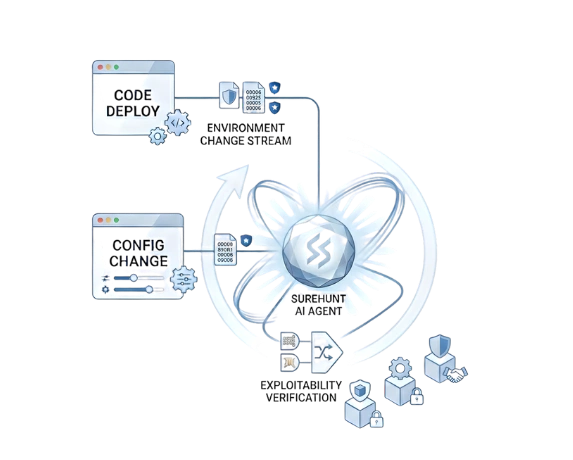
SureHunt connects weaknesses into real attack paths and validates exploitability, prioritizing only the risks that can actually lead to a breach.
Step 5 – Fix, validate, and stay protected
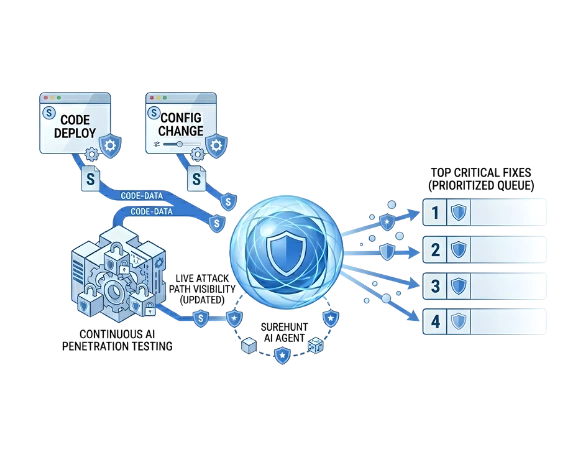
SureHunt connects individual weaknesses into multi-step attack paths
With guided remediation and automatic re-testing, SureHunt confirms that risks are fully resolved and continuously monitors for regressions as your system evolves.
0 Hrs
Average Pentest Time
0 %
PoC Evidence Rate
0 Hrs
Continuous Monitoring
Ready to simplify security and compliance?
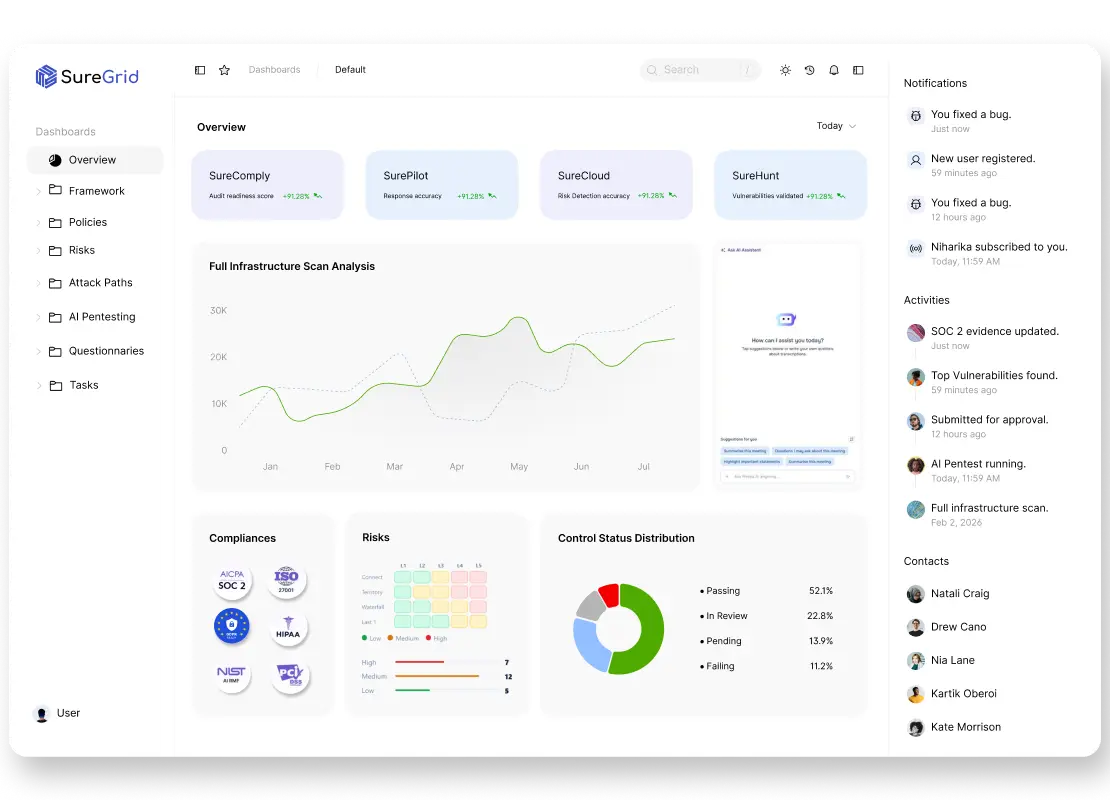
Unify compliance, cloud risk, AI penetration testing, and questionnaire automation to reduce exposure, accelerate audits, and respond faster.
What Our Clients Say

Matrimoney
CTO
Traditional pentests gave us static reports that became outdated quickly. SureHunt gives us continuous visibility into what is actually exploitable at any point in time.

Arthmate
Security Engineer
The attack path visualization is the most valuable part. It shows how multiple small issues combine into a real breach scenario.

Sahayog
DevSecOps Lead
We discovered a critical attack path that no scanner had flagged before. Individually the issues seemed low-risk, but together they were serious.

AuthBridge
Security Lead
The proof-of-exploit removes all ambiguity. We know exactly which issues are real and worth fixing.

ICICI Prudential
Head of Security,
It feels like having a continuous pentester working in the background. We don’t have to wait months to identify real risks.

Allianz
Engineering Manager
We were initially concerned about running tests in production. But it’s safe and controlled, and we haven’t faced any disruption.

True Value
Platform Engineer
It changed how we prioritize fixes. We now focus on breaking attack paths instead of patching everything blindly.

Flexiloans
Engineering Manager
It gives us confidence that we’re not missing hidden risks. Continuous testing has made our security posture much stronger.
Matrimoney
CTO
Traditional pentests gave us static reports that became outdated quickly. SureHunt gives us continuous visibility into what is actually exploitable at any point in time.
Arthmate
Security Engineer
The attack path visualization is the most valuable part. It shows how multiple small issues combine into a real breach scenario.
Sahayog
DevSecOps Lead
We discovered a critical attack path that no scanner had flagged before. Individually the issues seemed low-risk, but together they were serious.
AuthBridge
Security Lead
The proof-of-exploit removes all ambiguity. We know exactly which issues are real and worth fixing.
ICICI Prudential
Head of Security,
It feels like having a continuous pentester working in the background. We don’t have to wait months to identify real risks.
Allianz
Engineering Manager
We were initially concerned about running tests in production. But it’s safe and controlled, and we haven’t faced any disruption.
True Value
Platform Engineer
It changed how we prioritize fixes. We now focus on breaking attack paths instead of patching everything blindly.
Flexiloans
Engineering Manager
It gives us confidence that we’re not missing hidden risks. Continuous testing has made our security posture much stronger.

How is SureHunt different from traditional penetration testing?
Does SureHunt replace human pentesters?
Is SureHunt safe for production environments?
What kind of findings does SureHunt generate?
How are findings prioritized?
Can SureHunt integrate into CI/CD pipelines?
Does SureHunt provide proof-of-exploit evidence?
Stop relying on outdated pentest reports
Run your first test and see SureHunt uncover real attack paths in hours. Your team fixes validated risks instead of guessing what might be exploitable.
Continuous AI-driven pentesting
Real exploit validation
Clear, prioritized fixes
Trusted by over 3,000+ companies of all sizes






Build with us
We’d love to show you how Suregrid can help your business. Fill out the form and we’ll be in touch within 24 hours
For all updates & much more, mail on [email protected]
We respect your privacy.



