
Cyberattacks, project delays, compliance failures, and operational disruptions can affect any organization. Without a proper system to track and manage these uncertainties, businesses may face financial losses and reputational damage. A risk register helps organizations identify, assess, prioritize, and monitor risks before they become major problems.
What is a Risk Register?
A Risk Register is a comprehensive document that enables an organization to identify, assess, and rank the various risks involved in the risk management process. It captures and displays risks clearly and concisely, indicating the likelihood and consequences of a risk occurring, with an explanation of the risk mitigation measures.
Simplify Your Compliance & Stay Audit-Ready
Help your team manage controls, risks, and audits with ease
Why is the Risk Register Important?
This is important in any organization for many reasons:
- Helps Identify Risk Early: It allows business and project teams to spot potential issues before they arise. This early identification enables the organization to devise solutions to the problem before the risk impacts the organization.
- Improve the Quality of Decisions Made: In recording risks, management is able to make risk-informed decisions by evaluating the potential impact and likelihood of the risk and concentrating on the areas of concern.
- Increase Responsibility: Risks are allocated to individuals to ensure that everyone is responsible for documenting and managing risks for compliance, audit, and governance purposes. It helps to keep proper records and serves as evidence that the organization actively manages the risks.
- Improve Business Continuity: Organizations can create plans for the response and recovery from the major risks that would disrupt the business. This lessens the impact of unforeseen events like a cyber attack, an interruption in the supply chain, or a failure of a system.
- Enhances Communication: Using a centralized risk register, stakeholders can formulate and refine their strategies by reviewing the current risks and assessing the status of the risks.
What are the Key Elements of a Risk Register?
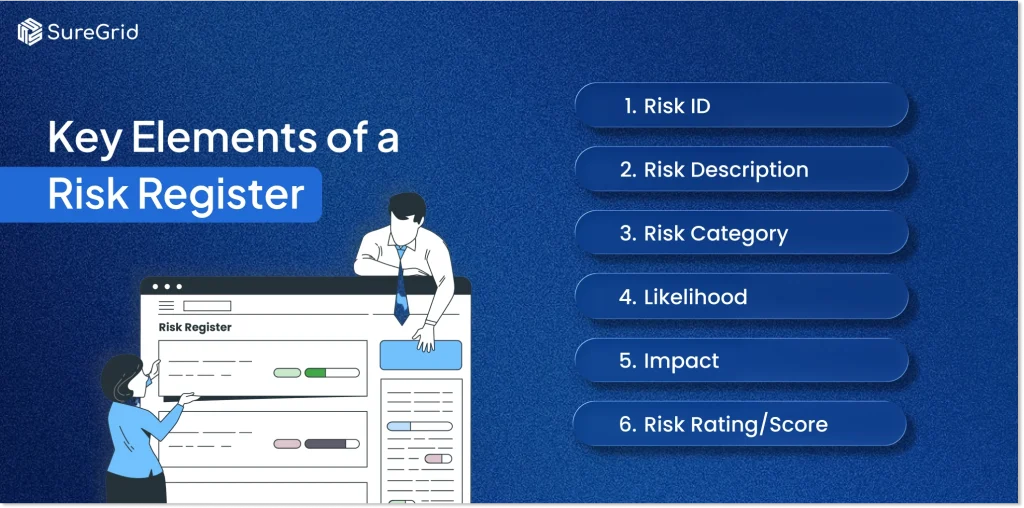
It is vital to be familiar with the key elements:
Risk ID: A designation assigned to each registered risk, allowing for easy reference by the project team.
Risk Description: A comprehensive and straightforward explanation of the risk that includes the mechanisms of its occurrence and potential effects on the project or the business.
Risk Category: A classification of risk that combines like risks for the purpose of analysis and reporting.
Likelihood: A rating of risk in terms of occurrence, generally expressed in low, medium, and high classifications.
Impact: This dimension expresses the severity of potential loss that may result from the occurrence of a risk. This could include loss of funds, operational failure, legal consequences, loss of reputation, delays in project completion, etc.
Risk Rating/Score: The formulation of the level of risk, based on likelihood and potential impact, for the purpose of establishing a level of priority and target for remediation.
Risk Owner: A person, team or organization assigned responsibility for the risk. E.g. IT Manager, Compliance Officer, and Project Lead.
Prevention Plan: This encompasses all the strategies to control the risk, including avoidance, reduction, and transference, as well as acceptance of the risk.
Current Status: This describes the existing state of the risk and if any action is being taken. Examples include: Open, In Progress, Mitigation, Closed and Under Review.
Review Date: This is the date when the risk will be reviewed/ recalculated. Continuous observation ensures that risks are assessed based on business conditions.
How to Prepare a Risk Register?
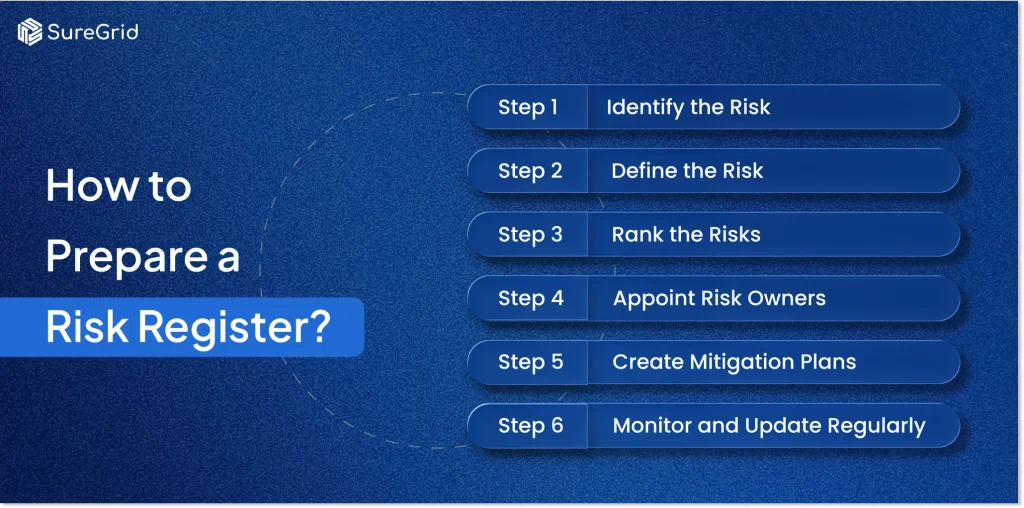
An organization can prepare a this comprehensive register by following the following steps:
Step 1: Identify the Risk
All possible aspects that can go wrong and that can harm the organization/ project should be collected.
Step 2: Define the Risk
Once the risks have been identified, review what the potential impact of that risk could be and how likely that risk happent. A risk that is highly likely and very impactful would typically require immediate consideration.
Step 3: Rank the Risks
All identified risks would typically not be of equal importance. Rank the risks based on their potential impact so that the team can tackle the highest-impact risks first.
Step 4: Appoint Risk Owners
All identified risks should have a specific individual/ team to oversee that risk and manage it. This ensures that the risks are not left unmanaged and promotes a culture of ownership.
Step 5: Create Mitigation Plans
Strategies for dealing with risks are developed in this step. There are four main routes that can be taken:
Avoid: Remove the risk completely.
Reduce: Decrease the likelihood or impact.
Transfer: Put the risk on someone else, in most cases through insurance.
Accept: Recognize the risk and keep an eye on it if it can’t be avoided.
Step 6: Monitor and Update Regularly
Regular reviews and updates of a risk register are necessary because of the mutable nature of risk. The risk information, therefore, remains current, and the organization can address new, emerging priorities quickly.
Conclusion
A risk register is not just an ordinary document. It is an important solution that helps organizations take proactive risk measures. If an organization regularly identifies and monitors risks, it can reduce and avoid impacts. A business should have this register to prepare for proactive measure than reactive measures.
FAQs
Ques: What is Risk Register?
Ans: It is a comprehensive document used to detect, assess, and track potential threats to a project or organization.
Ques: What are the 5 Steps of RM?
Ans: The five steps of RM are identify risks, analyze the risk, prioritize risks, treat the risk, monitor, and review the risks.
Ques: How to Create a Risk Register?
Ans: You can create a risk register by finding potential risks, assessing their impact, and probability, assigning an owner, planning mitigation strategies, and regularly monitoring and updating the risks.
Ques: What is the difference between a risk assessment and a risk register?
Ans: Risk assessment is a process of identifying and evaluating potential risks. Whereas register records, tracks, and manages those risks in an organized document.
Ques: What is the difference between a risk matrix and a risk register?
Ans: A risk matrix is a visual scoring tool that plots risk probability against impact to prioritize threats. A risk register is a comprehensive record.
Simplify Your Compliance & Stay Audit-Ready
Help your team manage controls, risks, and audits with ease