
Businesses tackle the compliance framework from a different perspective. Like each compliance requires its own processes, tools, and teams. However, a closer look tells different things.
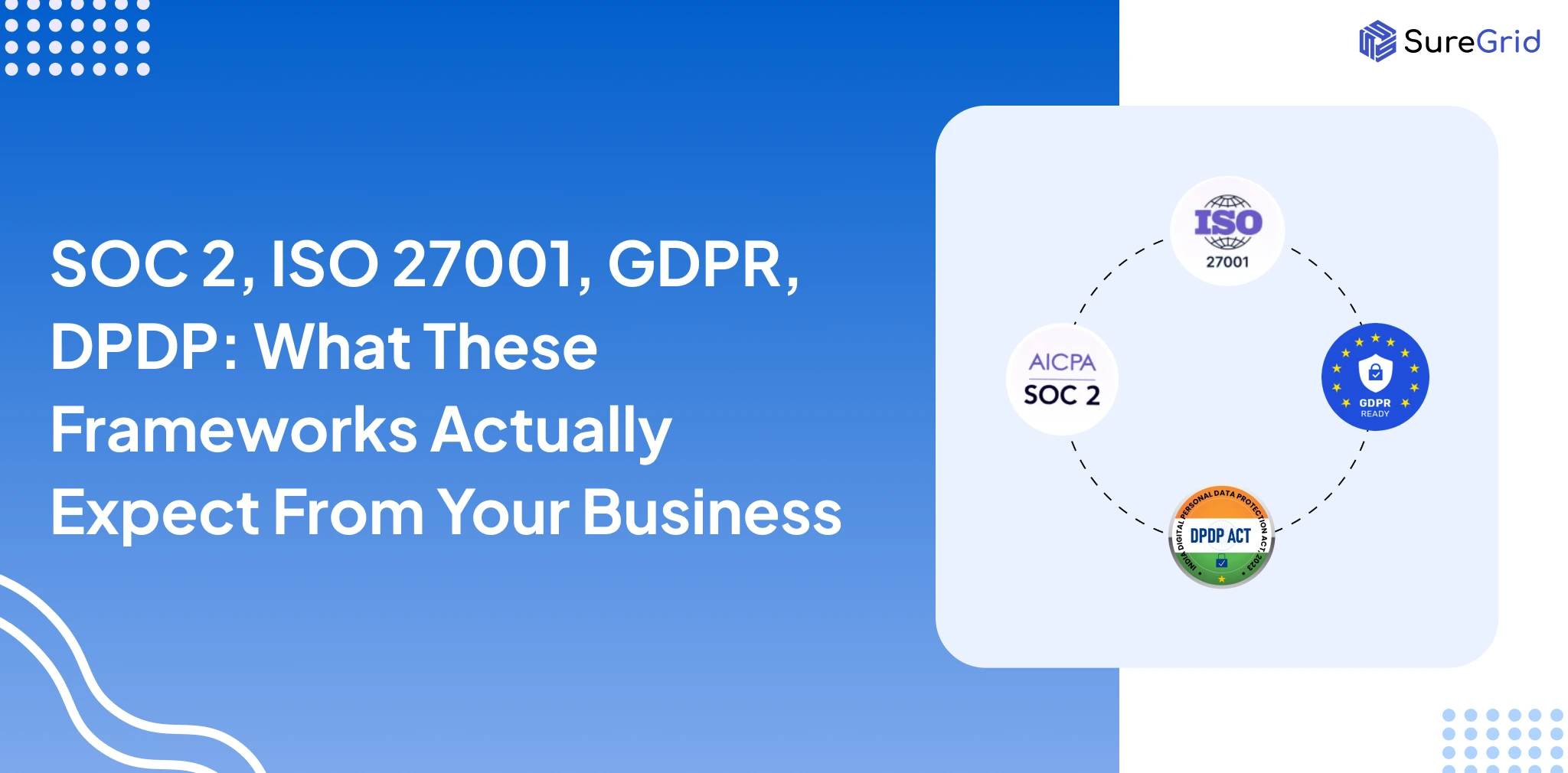
SOC 2, ISO 27001, GDPR, and DPDP may appear different as they use different terminology, formats, and operate in different regulatory environments. However, if you check thoroughly, you will find that each framework requires you to implement strong security controls, manage and mitigate risks, etc. In simple words, you don’t need to prepare from scratch for each.
Understanding all these frameworks helps you build a scalable and efficient compliance strategy.
Understand the Frameworks
Before exploring the similarities, it’s important to understand what each framework is.
SOC 2
SOC 2 is a compliance framework that the American Institute of Certified Public Accountants (AICPA) developed this framework. It is developed based on five Trust Service Criteria: Security, availability, processing, integrity, and privacy. Its main objective is to be properly designed and consistently operational.
ISO 27001
ISO/IEC 27001, is an internationally recognized standard for establishing and maintaining an Information Security Management System (ISMS). It emphasizes a structured, risk-based approach to managing information security. It creates a systematic process for identifying, assessing, and reducing security risks.
GDPR
The General Data Protection Regulation is a European Union Regulation focused on protecting personal data and ensuring privacy rights for individuals. Its main objective is to maintain lawful, transparent, and accountable processing of personal data.
Simplify Your Compliance & Stay Audit-Ready
Help your team manage controls, risks, and audits with ease
DPDP (India)
The Digital Personal Data Protection Act rules how organisations in India collect, process, and store personal data with a strong emphasis on consent and accountability. It focuses on responsible data handling with clear user consent and organizational accountability.
Why does the Compliance Framework Appear Different?
Most of the organizational things that frameworks need entirely different approach because of:
- Different terminology (controls, clauses, obligations)
- Different structures (audit vs certification vs regulation)
- Different jurisdictions (global vs EU vs India)
Common Expectations Across All Frameworks
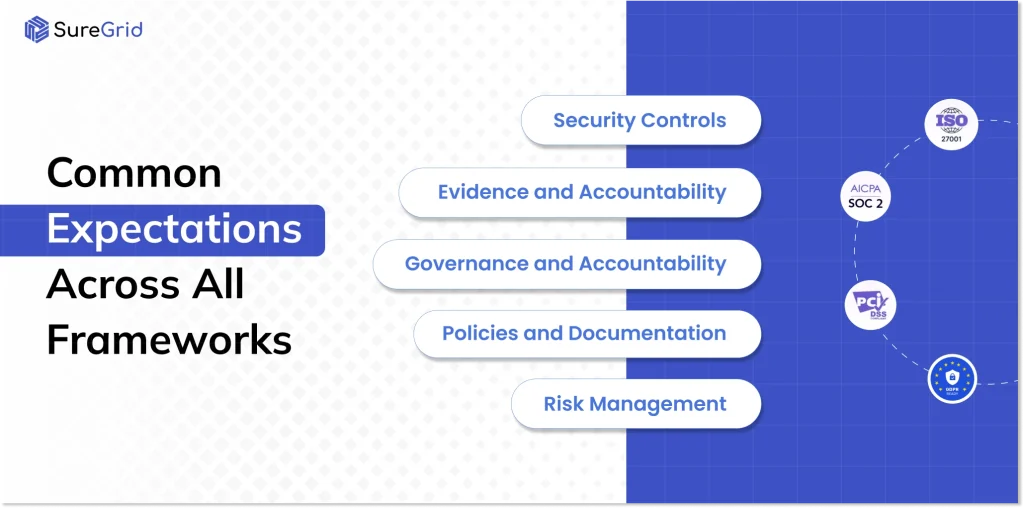
Don’t matter which is the framework, the business has to focus on the following pillars:
Security Controls
Every framework requires the implementation of appropriate technical and organizational measures to protect data.
It includes:
- Access control and identity management
- Data encryption and protection mechanisms
- Monitoring, logging, and alerting system
- Vendor and third-party risk management
Evidence and Accountability
Compliance does not believe word or intent; it requires evidence. Without evidence, it is not considered:
It includes:
- System and access logs
- Audit Trails
- Policy Acknowledgements
- Configuration and security reports
Risk Management
All frameworks focus on a proactive approach for identifying and managing risks.
This includes:
- Risk Identification
- Risk Assessment
- Risk mitigation planning
- Continuous monitoring and reassessment
Policies and Documentation
Policies are nothing but written rules that explain how a company handles security and compliance.
Common Policies Include:
- Information Security Policy
- Data Protection and Privacy Policy
- Incident Response Plan
- Access control and acceptable use policies
Governance and Accountability
Compliance needs clear ownership of the company. A business is accountable for compliance.
It involves:
- Defined roles and responsibilities
- Internal audits and reviews
- Leadership involvement
- Ongoing compliance monitoring
Why Do Organizations Struggle in Maintaining Compliance?
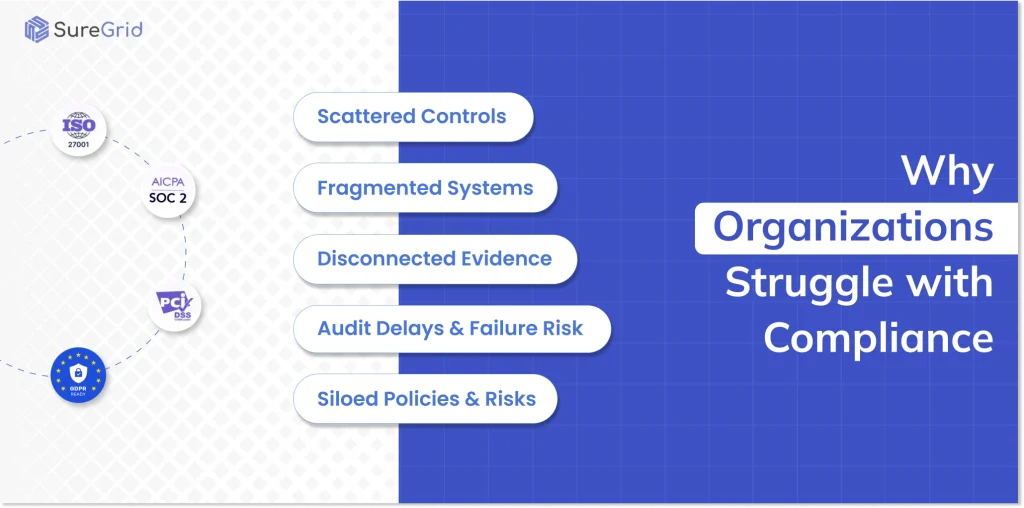
Organization struggle because of the operational approach. The biggest challenge is fragmentation across tools, teams, and processes. It is not present on a single platform. Like
- Controls are implemented in multiple systems
- Evidence is scattered across platforms
- Risk registers are maintained in spreadsheets
- Policies are stored in disconnected repositories
The unscattered data causes issues like:
- Duplication
- Document inconsistencies
- Increase Audit Preparation Time
- High risk of Audit Failure
Surecomply: A Smarter Solution for Business
Instead of a manual process, treat each framework separately. Organisations can use Surecomply, a unified compliance platform for business. It acts as a single system of record that helps businesses manage compliance in a structured way.
It allows an organization to:
- Manage controls and policies from a centralised dashboard
- Streamline evidence collection and management
- Maintain a unified risk register
- Eliminates duplicate efforts across multiple frameworks
- Enhances and streamlines audit preparation
- Reduce operational overhead and associated costs
Conclusion
SOC 2, ISO 27001, GDPR, and DPDP differ in structure and terminology. However, on understanding them, you will find that they work on the same fundamentals that include strong security controls, clear documentation, continuous risk management, and demonstrate accountability. Treating them differently and from scratch will add complexity, duplication, and inefficiency.
That’s why businesses need to shift from the framework-specific execution to a unified compliance strategy. Businesses can rely on SureComply to maintain consistency across all compliance requirements.
FAQs
Ques: Do I need to implement SOC 2, ISO 27001, GDPR, and DPDP Separately?
Ans: No, most of the compliance frameworks have similar requirements, such as controls, risk management, and documentation.
Ques: What is the main difference between SOC 2 and ISO 27001?
Ans: SOC 2 is a audit based attestation; it mainly focuses on how businesses operate controls. ISO 27001 is a certification standard that focuses on building a structured information Security Management System (ISMS).
Ques: Is SOC 2 a Certification?
Ans: No, SOC 2 is not a certification; it is an attestation report issued by an independent auditor.
Ques: What is the biggest challenge in Compliance?
Ans: The biggest challenge in compliance is fragmentation. Controls, evidence, and policies are scattered across tools and teams.
Ques: What does the audit ready actually mean?
Ans: In simple words, Audit Ready means:
- Controls are implemented
- Evidence is continuously collected
- Policies are documented
- Risks are tracked and mitigated
Simplify Your Compliance & Stay Audit-Ready
Help your team manage controls, risks, and audits with ease