
Companies don’t fail because they ignore the compliance requirements. They fail because they manage everything manually on spreadsheets, shared Google drives, emails, and internal docs. For fewer customers, it can be manageable, but handling a larger set of data manually is not possible. It can’t manage SOC 2, GDPR, and India’s DPDP Act. In this guide, why does the company face compliance failure when doing everything manually or not getting priority?
What is Compliance?
Compliance is the process of following laws, regulations, industry standards, and internal policies. It helps control how a company or an organisation works. This includes regulatory, security, financial, and operational compliance.
Being compliant with SOC 2, GDPR, and DPDP is essential for businesses to avoid penalties, legal action, damage to their brand reputation, and prevent operational disruptions.
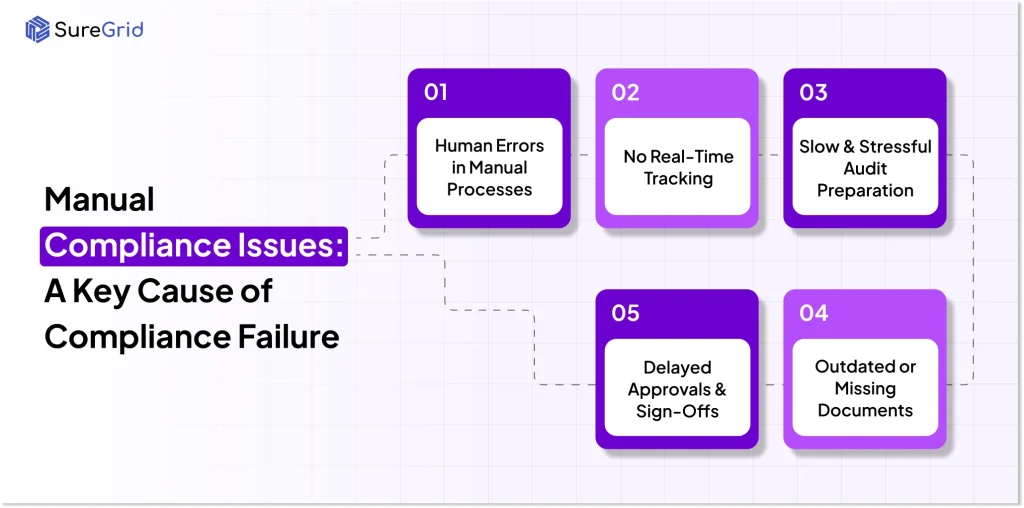
Manual Compliance Issues: Main Reason for Compliance Failure
Following compliance is essential for businesses. However, many companies fail to comply due to manual document handling:
- Manual Human Errors: Manual spreadsheets, emails, and paper-based forms often lead to typing mistakes, missed updates, and lost files. A minor error, such as an incorrect date or missing record, can lead to significant compliance failure. These errors often push organisations out of compliance, even when there is no intent to violate regulations
- No Tracking in real time: If your company is maintaining compliance data across folders, emails, and systems. You cannot track information in real time. Every auditor expects clear and complete proof, which is difficult to do when data is scattered and outdated.
- Slow and Stressful Audit Preparation: Manually preparing for an audit takes many days or even weeks. Team rushes to collect documents at the last minute, causing stress, confusion, and a high risk of missing essential evidence.
- Outdated or Missing Documents: Maintaining manual processes often results in old policies, missing approvals, or incomplete records. These small documentation gaps are common reasons companies fail compliance checks.
- Delayed Approvals and Sign-Offs: Manual follow-ups depend on emails and reminders that are easy to miss. When approvals are delayed, compliance deadlines are missed, creating unnecessary risk.
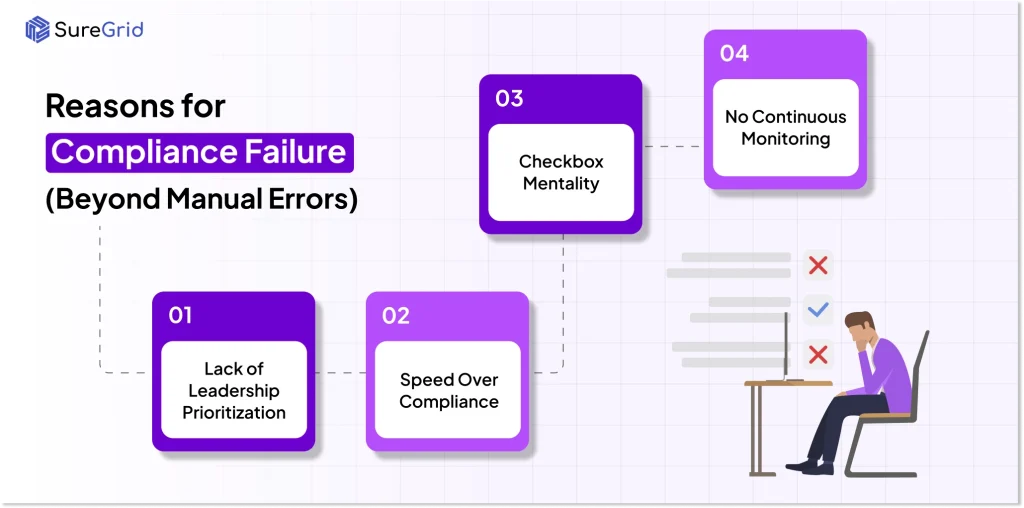
Reasons for Compliance Failure Other than Manual Issues
Apart from manual reviews, these are the reasons that lead to compliance vs non compliance challenges:
- Leadership Should Take Compliance as a Priority: When senior leaders do not focus on compliance with revenue and growth, emphasis and giving priority are necessary for rules to be followed. If the senior authority follows on compliance whole team gives preference to it.
- Encouragement for speed, not for following regulations: If employees get encouragement only for the speed, output, or target. They may skip compliance steps to save time. It creates shortcuts, incomplete checks, and violations of regulations.
- Compliance is treated as a checkbox: In many organisations, compliance is taken as simple paperwork. The team works manually just to finish work without any ownership or accountability. This mindset increases the risk of non-compliance, as teams focus on completion rather than correctness.
- Ignorance of regular monitoring: Regulations, business models, and threats change constantly. However, companies fail when they rely on one time risk assessment instead of reviewing risks continuously. Outdated risk views leave organisations exposed to new compliance risks.
Simplify Your Compliance & Stay Audit-Ready
Help your team manage controls, risks, and audits with ease
How Compliance Tools Help?
The automated tools are designed to manage compliance systematically and prevent teams from being out of compliance, while easing audits.
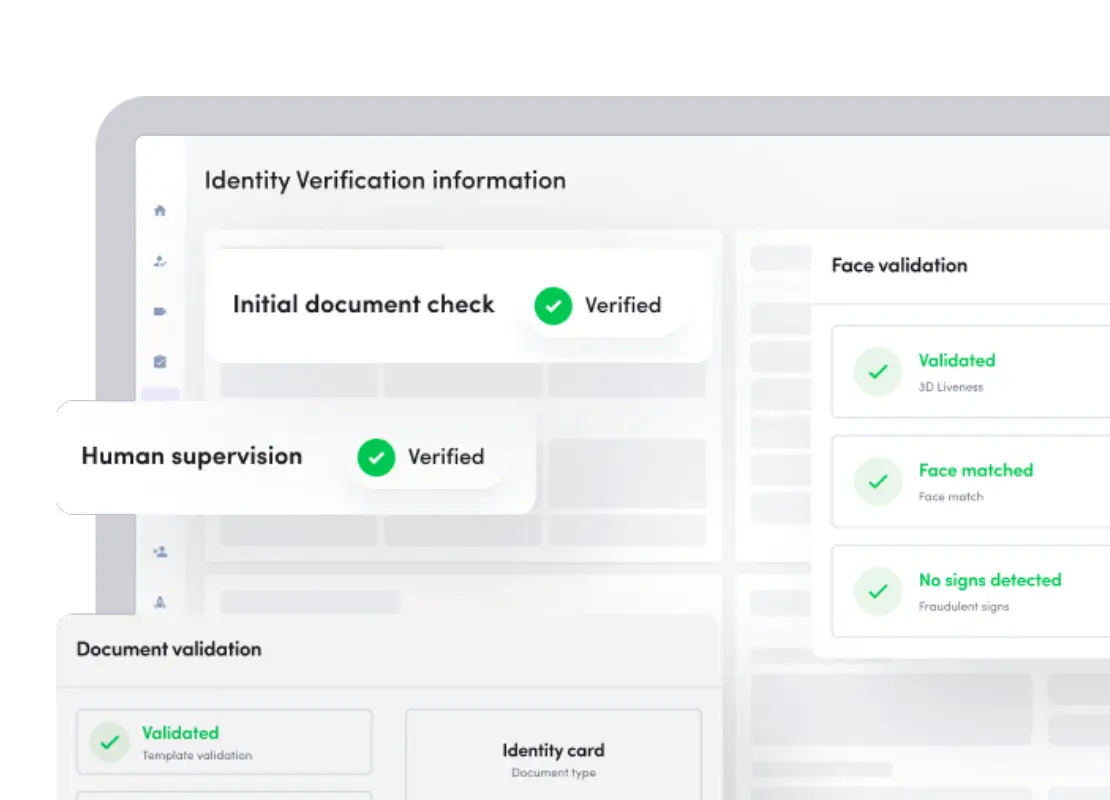
- Centralised Documentation and Dashboards: A compliance tool contains all the frameworks that a company must follow. It helps the company check, upload, and detect the risk.
- Automated Reminders and Workflows: On identifying the missed tasks, the user can easily assign tasks and meetings to overcome the compliance issues. It will become easier to manage rules as everything can be tracked in one place rather than in an unstructured form of data.
- Real Time Audit Evidence: As each document is stored and managed on a single platform. Documents and logs are always audit-ready. Instead of spending weeks preparing for audits, the compliance team can share evidence in minutes.
- Integrated Risk and Monitoring Systems: Compliance tools find the vulnerabilities to continuously track issues. It helps companies find problems early and fix them.
Checklist: Why You need to say goodbye to Manual Compliance Process
Check the following signs if you are facing challenges:
- At the time of the audit, you don’t have the required data and evidence to fix the compliance issues at the last minute.
- Do you find it difficult to find the compliance document or track them in real time.
- Does your compliance team spend too much time collecting evidence
- Do you find it hard to track compliance status
- Many approvals are delayed due to email follow-ups
- Policies and procedures are outdated or inconsistently followed
Conclusion
Companies often fail to follow compliance because they do not manage work in the right manner. Manual compliance handling is prone to human errors, tracking issues, outdated or missing documents, and delayed approvals. Apart from the manual compliance issues, it is not taken as a priority. Compliance Failure can bring legal and financial trouble to the company. To overcome this issue, the company should use a unified platform for managing and monitoring it.
FAQs
Ques: What are the compliance failures?
Ans: It occurs when an organisation does not meet legal, regulatory, or internal policy requirements.
Ques: What are the reasons for non-compliance?
Ans: The main reasons for non – compliance includes human errors, manual processes, lack of ownership, poor documentation, and weak leadership support.
Ques: Can technology help reduce compliance failure?
Ans: Yes, it helps reduce compliance failure.
Ques: What happens if a company is not compliant?
Ans: It can lead to fines, legal action, operational disruptions, reputational damage, and loss of business trust.
Ques: What are the top 3 compliance risks for an organisation?
Ans: It includes regulatory changes, data and security breaches, and failures caused by manual or fragmented compliance processes.
Simplify Your Compliance & Stay Audit-Ready
Help your team manage controls, risks, and audits with ease