
PSI DSS Certification is essential for every company handling sensitive information about cards (Debit/Credit). It protects against cyber attacks as well as data breaches risk. In this blog, you’ll be able to learn about the certification thoroughly.
What is PCI DSS Certification?
PCI DSS (Payment Card Industry Data Security Standard) Certifies that an organization adheres to the security standards to safeguard the data of cardholders. It is the PCI Security Standards Council created these standards for all organizations that process, store, and send information about payment cards.
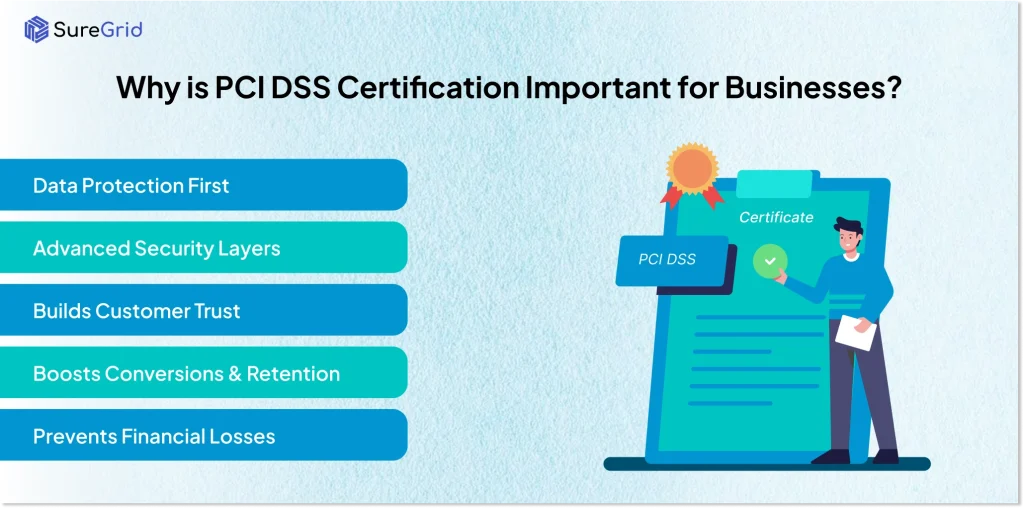
Why is PCI DSS Certification Important for Businesses?
This is a must-have for companies due to the reasons listed below:
- Guard the sensitive information of Customers: This provides a comprehensive system to protect cardholders from information breaches, theft, and fraud. It employs secure security, encryption, and a secure network along with access control. This helps reduce the threat of hacking and data leaks.
- Customer’s Trust: Customers have confirmation that the business is following the rules and is trustworthy. The customer is more secure, and they can give their credit card information. This helps to increase the rate of conversion, higher customer retention, and an excellent reputation for your brand.
- Protects against financial losses: Data breaches can result in penalties and fines, monetary reimbursement to customers, and legal fees.
Simplify Your Compliance & Stay Audit-Ready
Help your team manage controls, risks, and audits with ease
Who Needs PCI DSS Certification?
It’s a requirement for every business that needs to store, process, or send the data of cardholders. This includes e-commerce, merchant banks, retail stores, and service providers like payment gateways.
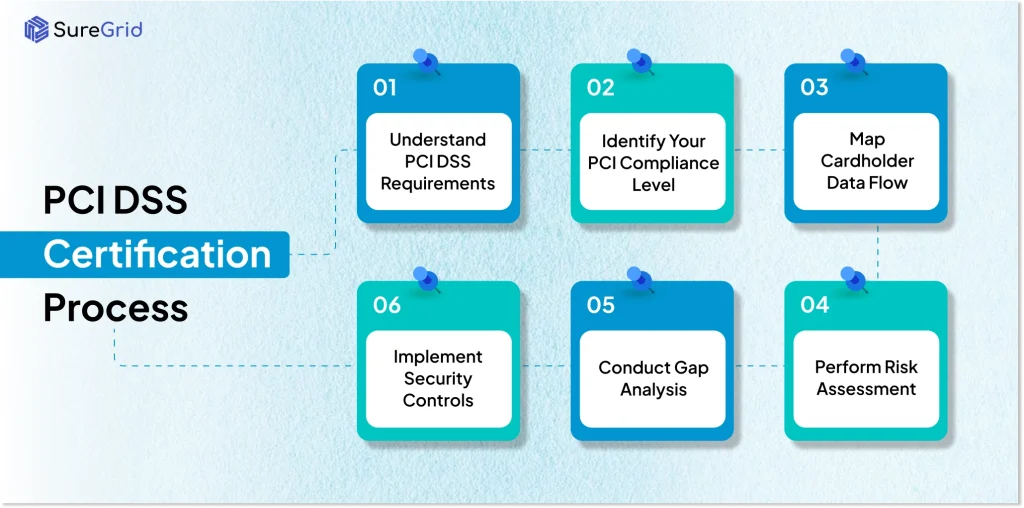
PCI DSS Certification Process
This process completes in several steps:
- Understand PCI DSS Requirements: The first step toward PCI DSS certification is to know all 12 PCI DSS requirements. The requirements cover areas like the security of networks and access control, protection of data surveillance, as well as security procedures. It is the basis of your compliance strategies.
- Identify Your PCI Compliance Level: Verify the PCI compliance status in relation to your monthly transactions with a credit card. The classification identifies the criteria for validating the organization requires a Self Assessment Questionnaire (SAQ) or a Qualified Security Assessor (QSA).
- Map Cardholder Data Flow: Find out how the data of your cardholder flows through your system. It reveals where the data is processed, stored, and then transmitted. This creates a transparent data flow diagram that assists in identifying risk areas and provides complete transparency.
- Perform Risk Assessment: Complete a risk assessment in order to discover weaknesses in your network, systems and processes.
- Conduct Gap Analysis: Examine the security situation currently with PCI DSS specifications. The gap analysis fails to identify security controls and points that require improvement before proceeding.
- Implement Security Controls: Address security concerns through the application of crucial control measures, such as:
- Data encryption
- Network security and firewalls
- Secure access control mechanisms
- Systems for monitoring and logging
- Complete SAQ and Hire QSA
Once you have implemented security measures, the next step is:
- Lower Levels: Complete the Self-Assessment Questionnaire (SAQ)
At higher levels, you can engage an experienced qualified security assessor (QSA) to validate your formality.
- Perform Internal Audit: Before the final validation, conduct an audit internally to confirm that all controls are properly installed and working as they should.
- Undergo External Audit: If needed, the QSA can carry out an external audit to ensure conformance. This process confirms the organization’s compliance with PCI DSS standards.
- Obtain Certification (AOC/ROC)
- Following verification, you’ll be notified:
- Attestation of Compliance (AOC)
- Report on Compliance (ROC) (for Level 1 Organizations)
What is PCI DSS Certification Cost?
The cost for Certification isn’t set and is based on the organization’s size, volume of transactions, as well as compliance requirements. The certification includes several components, like auditing costs, training, equipment, and regular maintenance.
- Small businesses who have an SAQ: $1,000 to $10,000 annually
- Mid-Sized companies: $1,000-$10,000 per year
- Large Enterprise: $50,000 – $500,000+ per year
PCI DSS Certification Renewal Process
Getting this certificate one time is not a life-long confirmation. Companies must renew it every year. This involves re-certification of and the Self Assessment Questionnaire, or Qualification Security. It is recommended that the company conduct periodic vulnerability checks, keep track of security measures, and then modify policies in order to comply with the current PCI DSS requirements.
FAQs
Ques: What exactly is PCI DSS certification?
Ans: It’s a legal security requirement for all businesses that store, process, or transmit credit/debit card data.
Ques: What is the time frame for PCI DSS certification?
Ans: The process of obtaining certification takes anywhere from three to nine months.
Ques: Does PCI DSS have to be mandatory?
Ans: Yes, this certification is a requirement.
Ques: What is the frequency of renewals?
Ans: The contract must be renewed every year.
Ques: What happens if you’re in violation?
Ans: If an organization isn’t PCI DSS compliant. The company could be subject to fines, concerns with the law, and even security breaches.
Simplify Your Compliance & Stay Audit-Ready
Help your team manage controls, risks, and audits with ease