
Modern businesses are like large ships sailing through unpredictable oceans. To stay on course, avoid obstacles, and follow the law, every company needs a solid plan. In the business world, this plan is known as GRC. In this blog, you will learn exactly what GRC is, how organizations use it, and why it is necessary for every modern business.
What is GRC?
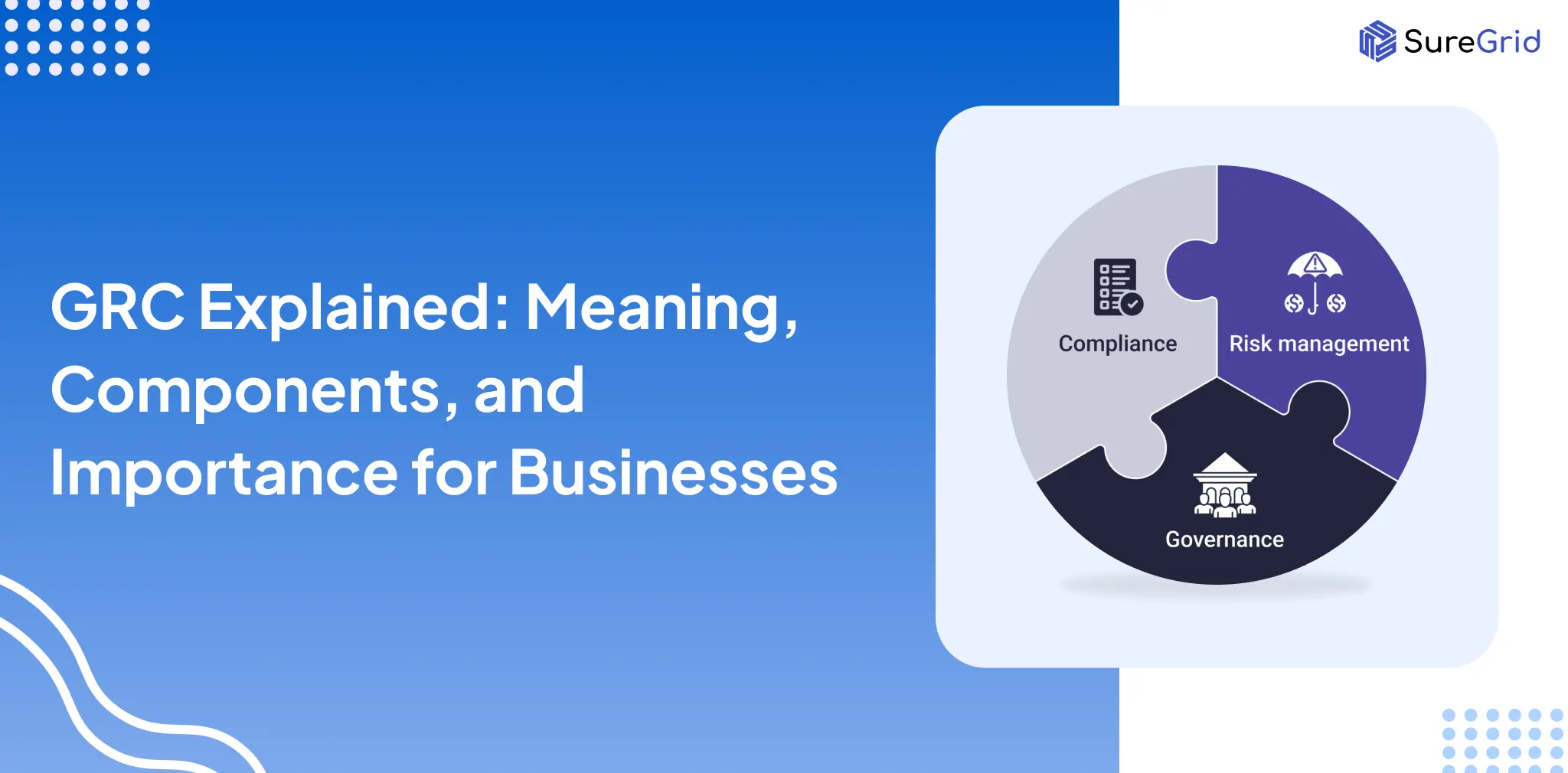
GRC stands for Governance, Risk, and Compliance. These three elements create the structure for a functioning organization. Governance establishes the plan and procedures, Risk Management analyzes uncertainties regarding the plan, and Compliance confirms the company meets both statutory and internal standards. These elements working together create the “brain” for the company, allowing it to function with ethics, security and systematization, while avoiding the risks associated with errors and the law.
The Three Pillars of GRC Explained
Let’s understand what is GRC by breaking down its components:
Governance
Governance means leadership and direction. It refers to the framework of rules and processes that determine how an organization is directed and controlled. It focuses primarily on accountability and integrity, ensuring that those who are at the top of an organization control it and uphold the organization’s goals and objectives.
- Simple Example: Think of a school. The principal sets the rules, defines the grading system, and decides the school’s goals. That is “governance.” It ensures the teachers and students know what is expected of them.
Risk Management
Risk means the unseen threats that could impede the achievement of an organization’s goals and objectives. Risk Management is the act of detecting those threats and devising means of their mitigation.
- Simple Example: If that same school is located in an area prone to rain, a “risk” is a leaky roof. Risk management would be checking the roof regularly and having a repair fund ready.
Compliance
Compliance means to adhere to a rule. The rule could be company related (internal policies) or government related (laws). Compliance is an act that ensures a company is law abiding.
- Simple Example: A school must follow fire safety laws. Having fire extinguishers and regular fire drills is “compliance.” If they don’t do this, the government might shut them down.
Simplify Your Compliance & Stay Audit-Ready
Help your team manage controls, risks, and audits with ease
What is GRC in Cyber Security?
Technology is at the heart of almost every business today. Because of this, GRC has become a massive part of the tech world. But what is GRC in cyber security specifically?
In the digital world, GRC helps IT teams protect sensitive information. It isn’t just about installing antivirus software; it’s about having a master plan for digital safety.
Data Protection
Companies hold a lot of private data, like your credit card numbers or home addresses. GRC ensures that only the right people have access to this data and that it is encrypted (locked) so hackers can’t read it.
Risk Mitigation
In cyber security, risks include things like phishing emails or system crashes. A GRC framework helps a company rank these risks. For example, a risk that could take down the whole website is treated as more urgent than a small glitch in the employee chat app.
Regulatory Requirements
There are many laws, like the GDPR in Europe or HIPAA in healthcare, that dictate how digital data must be handled. GRC tools track these laws to make sure the company doesn’t accidentally break them and face millions of dollars in fines.
Why is GRC Important?
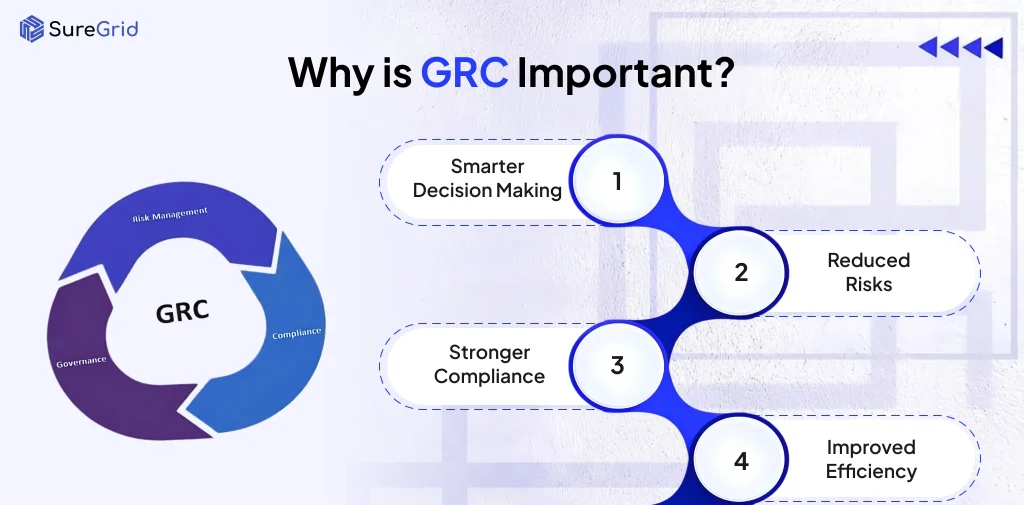
You might wonder, “Can’t a company just work hard and hope for the best?” Not really. As a business grows, it becomes too complex to manage by “gut feeling.” Here is why GRC is essential:
- Better Decision Making: When leaders have a clear view of their risks and goals, they can make smarter choices about where to spend money and time.
- Reduced Risks: GRC helps find “holes” in the business before a disaster occurs. This saves the company from losing money or its reputation.
- Improved Compliance: Laws change all the time. GRC systems keep track of these changes so the company is never caught off guard.
- Operational Efficiency: Instead of every department having its own set of rules, GRC creates one unified system. This stops people from doing the same work twice and speeds everything up.
What is SAP GRC?
The larger a company grows the more difficult it becomes to manage and they become reliant on software. SAP is one of the largest providers of corporate software. SAP GRC is their solution for Governance, Risk, and Compliance.
SAP GRC is for larger companies and removes the need for GRC to take place via cumbersome spreadsheets and emails, replacing them with an easier solution.
How SAP GRC Helps:
- Access Control: It makes sure that an employee in the warehouse can’t accidentally access the company’s bank accounts.
- Audit Management: It keeps a digital paper trail of everything that happens, making it easy for “auditors” (people who check the company’s work) to see that the rules are being followed.
- Fraud Prevention: It can automatically flag suspicious activity, like someone trying to pay themselves twice.
How GRC Works (A Simple Explanation)
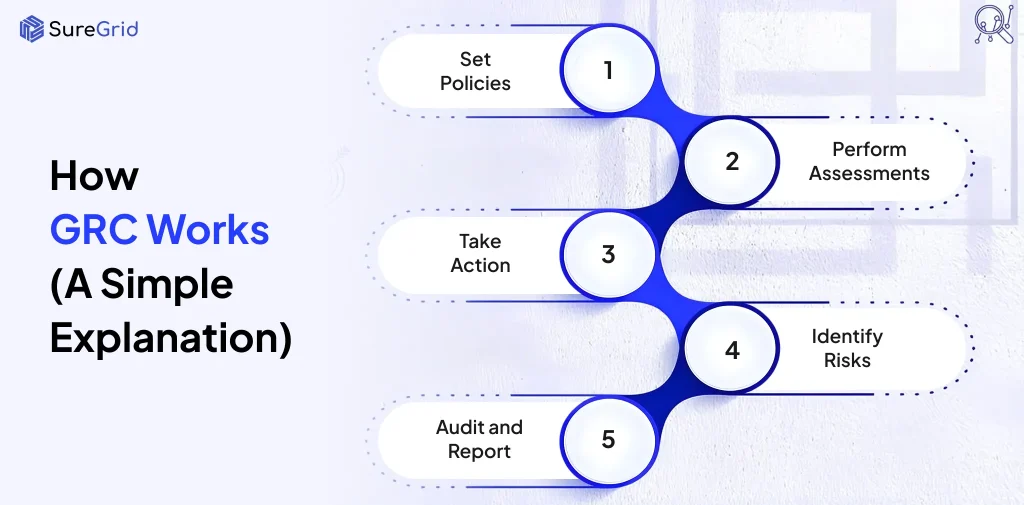
How does a company actually “do” GRC? It usually follows a simple cycle:
- Set Policies: The company writes down the rules. “Every employee must change their password every 90 days.”
- Identify Risks: The team asks, “What if an employee uses a weak password?”
- Perform Assessments: They check the current system to see how many people are actually following the password rule.
- Take Action: If many people are failing, they might install a tool that forces a password change automatically.
- Audit and Report: Once a year, they check the whole process to see if it worked and show the results to the bosses.
Examples of GRC in Real Life
To make this even clearer, let’s look at two relatable business scenarios.
Example A: The Online Clothing Store
A small online shop starts growing.
- Governance: The owner decides the company will only work with ethical factories.
- Risk: A factory might start using child labor without the owner knowing.
- Compliance: The owner sets a GRC policy to visit every factory once a year for an inspection to comply with international labor laws.
Example B: The Local Bank
- Governance: The bank board decides that customer trust is the #1 priority.
- Risk: A hacker could steal customer money.
- Compliance: The bank must follow strict banking laws that require them to report any suspicious transfers over $10,000. Their GRC software automatically flags these transfers for the government.
Conclusion
The most reliable system that all businesses can model their operations on for safety, efficiency, simplicity and good ethics is the GRC (Governance, Risk, and Compliance) model. Absorbing the best practices in leadership and direction (Governance), risk identification and management (Risk), and the best practices for adherence to internal and external guidelines (Compliance) equips organizations to avert the detrimental effects of financial and reputation loss. Whether they take the form of policy prescriptions or the use of automated systems such as SAP GRC, the best GRC systems for the most critical domains, especially cyber security, assures the business units of a company that they not only remain in the game but actually build the impetus to win by deepening the trust of all their stakeholders (employees, partners, and customers).
FAQs
Ques: What is GRC?
Ans: GRC refers to Governance, Risk, and Compliance. GRC has adequate control of business, risk management, and running an organization in a lawful manner.
Ques: What is the full form of GRC?
Ans: GRC embodies Governance, Risk Management, and Compliance. The interrelation of these elements ensures the effective and responsive administration of an organization.
Ques: What is governance, risk, and compliance (GRC)?
Ans: Governance, risk, and compliance (GRC) is an approach to running a business that combines the following elements:
- creates policies (governance)
- identifies and mitigates risk (risk management)
- ensures adherence to laws and rules (compliance)
Ques: What is GRC in cyber security?
Ans: GRC practices in information security help a business to increase the security of its information, control security threats, and keep its information safe according to laws like HIPAA and GDRP.
Ques: Why is GRC important for businesses?
Ans: GRC is essential for businesses because it enables them to:
- enhances the quality of decision-making
- minimize exposure to threats
- achieves the status of a lawful enterprise
- overall efficiency GRC.
Ques: What is SAP GRC?
Ans: SAP GRC is a tool for enterprise governance, risk, and compliance that is a system of SAP that is built to help businesses use automatic mechanisms instead of manual mechanisms.
Simplify Your Compliance & Stay Audit-Ready
Help your team manage controls, risks, and audits with ease