
Every time a customer enters their credit card details on your site, they trust you with their financial information, and if that information gets leaked or is misused the consequences for the customers and the business can be devastating. PCI Compliant hosting is a contractual requirement for anyone who accepts, processes, or stores card data. In this blog, we’ll discuss what PCI compliant hosting is and why it is essential for securing your business and building lasting trust with your customers.
What Is PCI Compliant Hosting?
PCI Compliant web hosting is a web hosting environment that meets the strict security guidelines of the Payment Card Industry Data Security Standard (PCI DSS) to keep cardholder data safe.
PCI DSS isn’t a law made by a government, but a set of rules made by payment network companies like Visa, Mastercard, and American Express. These guidelines ensure that any company handling cardholder information maintains a standard for data security to prevent any data leaks or misuse of the people who use their payment networks.
Simplify Your Compliance & Stay Audit-Ready
Help your team manage controls, risks, and audits with ease
Why Does PCI Compliant Hosting Matter?
Businesses might assume that fraudsters won’t target them due to their small scale, but in reality, small businesses are often preferred targets because they have weaker security than well-established companies.
Failing to use a PCI DSS-Compliant hosting environment can lead to:
- Financial Penalties: Banks and card brands may impose fines ranging from $5,000 to $100,000 per month until compliance is achieved.
- Data Breaches: Even one data breach could cost thousands in forensic audits, legal fees and loss of customer trust.
- Loss of Reputation: Once customers lose confidence in your platform, they rarely return.
- Revoked Privileges: In extreme circumstances, accepting credit card payments altogether could become impossible.
Key Features of a PCI Compliant Hosting Environment
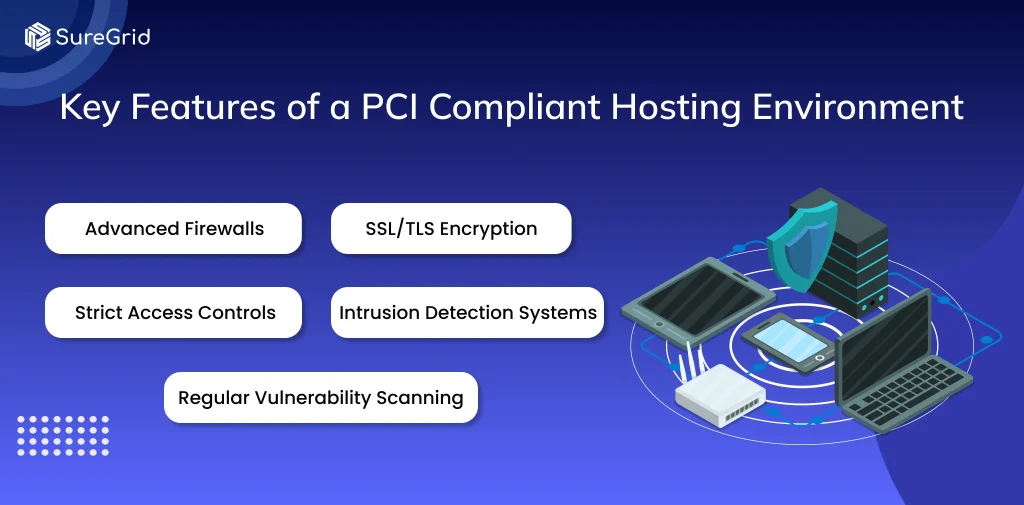
A truly compliant hosting environment isn’t just about a “badge” on a website. It involves several layers of technical and physical protection.
- Advanced Firewalls: A firewall acts as a digital security guard. It monitors all incoming and outgoing traffic and blocks anything that looks suspicious or unauthorized.
- SSL/TLS Encryption: This is the technology that creates a secure “tunnel” between your customer’s browser and your server. It ensures that even if someone intercepts the data, they can’t read the credit card numbers.
- Regular Vulnerability Scanning: Hackers constantly find new “holes” in software. A compliant host performs regular automated scans to find these weaknesses before the bad guys do.
- Intrusion Detection Systems (IDS): Think of this as a burglar alarm for your data. These systems monitor for unusual activity—like someone trying to guess a password thousands of times—and alert security teams instantly.
- Strict Access Controls: Not every employee at a hosting company should have access to the servers. Compliance requires that access is limited only to those who absolutely need it to do their jobs.
- Physical Security: Compliance extends to the real world. The data centers where servers live must have 24/7 security, biometric scanners, and cameras to prevent unauthorized physical access.
PCI DSS Compliance Levels Explained
Not every business has the same requirements. The “Level” you fall into depends on how many transactions you process each year.
- Level 1: Over 6 million per year. These businesses require an annual audit by a third-party.
- Level 2: 1 million to 6 million transactions. Requirements are still high but slightly more flexible.
- Level 3: 20,000 to 1 million transactions. This is where many successful mid-sized businesses fit in.
- Level 4: Fewer than 20,000 transactions. This applies to most startups and small businesses.
Shared Hosting vs. Dedicated Hosting for PCI Compliance
When looking for PCI compliant hosting providers, you’ll likely see two main options.
Shared Hosting: You share a server with hundreds of other websites. While cheap, this is often a nightmare for PCI compliance. If one “neighbor” on your server has a security hole, it could potentially put your data at risk. Most experts recommend avoiding shared hosting for serious eCommerce.
Dedicated or Managed Cloud Hosting: This is the gold standard for compliance. You have your own “space” that isn’t touched by other businesses. It is much easier to secure, audit, and maintain to the high standards required by the PCI Council.
How to Choose the Right PCI Compliant Hosting Provider?
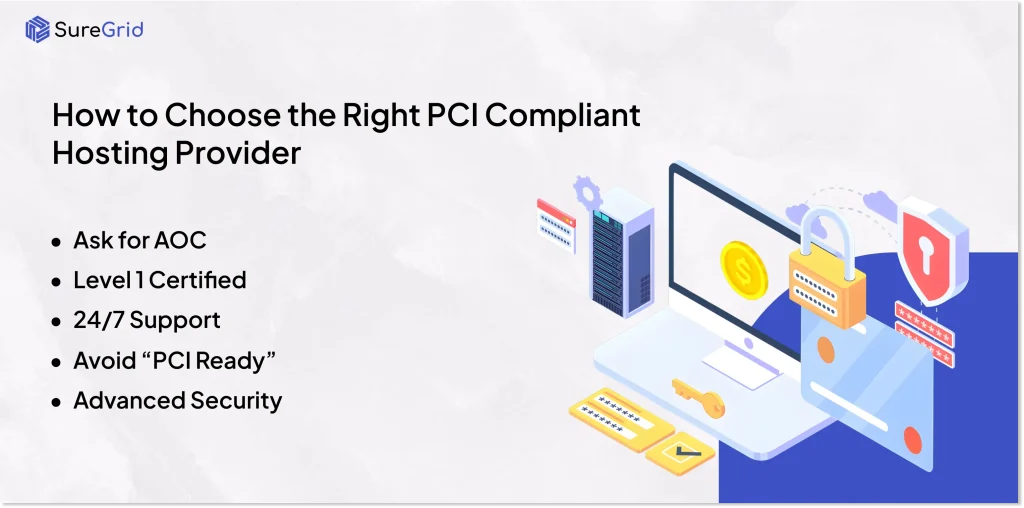
Choosing a partner is a big decision. Here are a few practical tips to find the right PCI compliant hosting provider:
- Ask for the AOC: Request an “Attestation of Compliance.” This is a document signed by an auditor proving the host is compliant with all the norms. If they refuse, walk away.
- Check for Level 1 Certification: Even if you are a small business, choosing a host that is “Level 1 Certified” means you are getting the highest level of security available.
- Look for 24/7 Support: Security issues can happen at any time, make sure that support is available all the time.
- Avoid “PCI Ready” Claims: Some hosts may have the label “PCI Ready”, this is a vague term which can even mean that they are not compliant with PCI DSS completely. Always make sure that the host claims “PCI Compliant”
Conclusion
Security is a factor that enhances your credibility as a business. If you select a PCI compliant hosting service provider, you will be able to eliminate the regulatory burden and show your clients that you are concerned about their security. Businesses should evaluate their pci hosting options and determine if the host is able to keep the business and it’s customers safe.
FAQs
Ques: What is PCI compliant hosting?
Ans: PCI compliant hosting is a web-hosting environment that meets the security guidelines as per PCI DSS to protect cardholder data during storage, processing, and transmission.
Ques: Who Needs PCI Compliant Hosting?
Ans: Following businesses need PCI Compliant Hosting:
- eCommerce platforms
- SaaS platforms
- Offline businesses such as retailers, restaurants, salons, and any other business that accepts card payment
- Non-Profits Organisations
Ques: What happens if my business is not PCI DSS compliant?
Ans: Non-compliant businesses can face issues such as heavy penalties, data leaks, and in some extreme cases payment network companies may not allow the business to accept payments from their cards.
Ques: What is the difference between PCI compliant and PCI ready hosting?
Ans: “PCI compliant” refers to providers that meet PCI DSS standards, while “PCI ready” can refer to an organisation without full compliance being guaranteed.
Ques: How often should PCI compliance be validated?
Ans: PCI compliance should be validated annually, with regular scans and monitoring throughout the year.
Ques: Does using a PCI compliant hosting provider make my business fully compliant?
Ans: No, hosting is just one part your business must also follow security practices for full compliance.
Ques: Can I use third-party payment gateways to reduce PCI compliance scope?
Ans: Yes, third-party gateways handle card data, reducing your compliance burden.
Simplify Your Compliance & Stay Audit-Ready
Help your team manage controls, risks, and audits with ease