
Artificial intelligence (AI) is being integrated into day-to-day work. Employees are using free AI tools and online platforms to do the work faster and easier, without necessarily understanding what happens to the data they input, store or share through such means. Sometimes such solutions are not even formally submitted or approved by the company’s internal IT and security departments, thus creating new technology related risks for the organization.
Shadow AI may look similar to Shadow IT , but AI tools can generate new risk concerns around data exposure, privacy, security, and governance that IT.
What is Shadow AI?
Shadow AI happens when employees use AI-powered tools or features without official IT approval or oversight from their organisation. The term does not mean that an employee is using AI for an improper purpose. An employee using an AI tool to summarise information, draft content, analyse data, or complete code is normal, but it becomes Shadow AI when that use falls outside the organisation’s established approval.
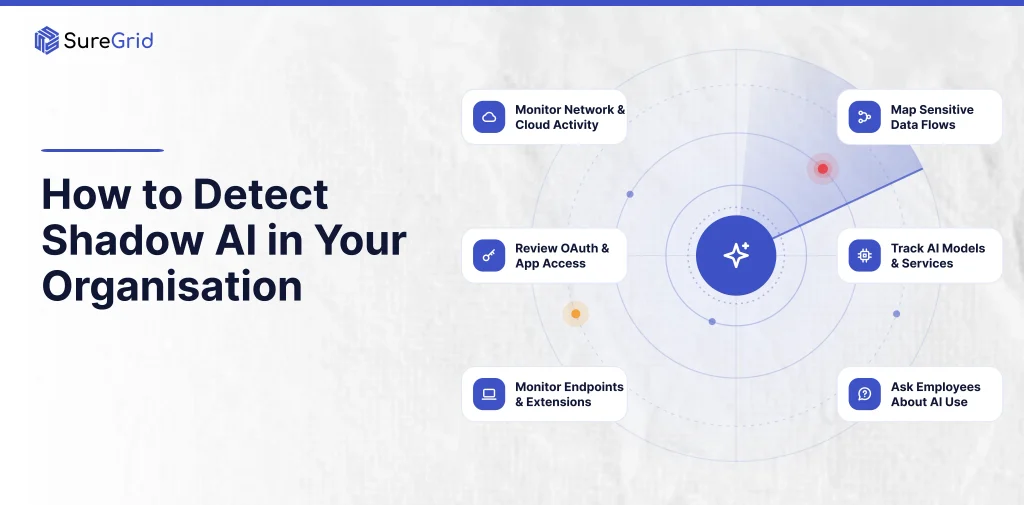
How to detect shadow AI?
Steps to detect shadow AI are-
Monitor network and cloud activity
Network monitoring, secure web gateways, and Cloud Access Security Broker (CASB) capabilities can help identify connections to known AI services, generative AI platforms, and AI APIs. This can reveal AI services being accessed outside the organisation’s approved environment.
Review OAuth and third-party application access
Organisations should regularly review OAuth permissions and third-party application connections in platforms such as Microsoft 365 and Google Workspace. An unapproved AI application may obtain access to email, documents, calendars, or other business data through these connections.
Monitor endpoints and browser extensions
Endpoint and browser controls can help find unapproved AI extensions, plugins, and applications. This is especially useful for extensions that can access webpage content or send information from the browser to an external AI service.
Simplify Your Compliance & Stay Audit-Ready
Help your team manage controls, risks, and audits with ease
Map sensitive data flows
Data Security Posture Management (DSPM) tools can help organisations understand where sensitive data is stored and how it moves between systems. This can support the identification of data flows involving AI services that have not been formally assessed.
Identify AI services and models used in development environments
For organisations that develop software or use AI systems, AI Security Posture Management (AI-SPM) tools can help track the AI models and services being used. This can also help identify AI models or components that developers have added.
Understanding employee AI usage
Technical monitoring should be combined with employee surveys and regular team checks. Employees may use AI features that are hard for IT teams to spot, especially when those features are built into software the organisation already uses.
What is the Shadow AI economy?
The Shadow AI economy refers to the growing use of AI tools by employees for work outside their organisation’s officially approved AI systems and processes.
Instead of waiting for an organisation to provide an approved AI solution, employees may independently use tools such as ChatGPT, Claude, Gemini, coding assistants, or AI features in other applications to complete everyday tasks.
Why do employees choose Shadow AI?
Employees generally turn to Shadow AI because of some common reasons.
- Ease of Access: Many AI technologies can be found on the Internet and are available for free or with low-cost plans. That is why employees use it.
- Speed of Work: Employees can use AI to create text documents, write, summarize paperwork, conduct analytical processes, and come up with new ideas.
- Gaps in approved tools: If an organisation has not provided an AI tool for a particular task, employees may look for an alternative themselves.
- Knowledge of Consumer AI: Employees may already use AI tools personally and naturally bring those tools into their work.
- Testing: Employees may want to test new AI capabilities before the organisation has formally evaluated or adopted them.
- Advantage: An external AI service may offer a feature that is not available in the organisation’s existing software.
What Security Threats Can Shadow AI Create?
The main risks include:
- Sensitive data exposure
- Data retention and reuse
- Weak access controls
- Third-party and supply-chain exposure
- Insecure AI-generated code
- Malicious or manipulated inputs
- Uncontrolled integrations
- Loss of security visibility
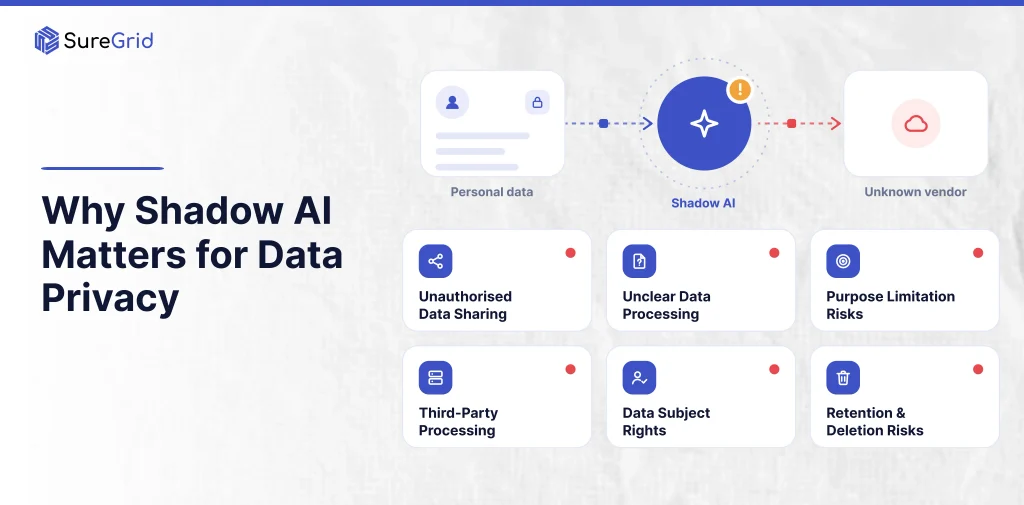
Why does Shadow AI matter for data privacy?
There are Several privacy considerations that make Shadow AI important.
- Unauthorised data sharing: Employees may submit customer information or other personal data to an AI service without the appropriate internal approval or safeguards.
- Unclear data processing: The organisation may not know where the AI provider stores or processes the data, how long it keeps it or whether it shares it with other providers.
- Purpose limitation: Personal data collected for one business purpose may be entered into an AI tool for another purpose. Organisations need to ensure that such use is consistent with the applicable legal basis and stated purpose for processing.
- Third-party processing: AI tools may process personal data on behalf of an organisation or act as a separate provider depending on the arrangement. Organisations need to understand how the provider handles the data and what contractual protections apply.
- Data subject rights: When personal data is sent to an unmanaged AI tool, it can become harder to find and manage that data when someone requests access, correction or deletion.
- Retention and deletion: An unapproved AI tool may create another place where personal data is stored. This can make it harder for organisations to follow their existing data retention and deletion practices.
How the Risk Profile of Shadow AI Differs from Shadow IT?
The main differences are:
- Data processing: Shadow IT may store or transfer business data through an unapproved service. Shadow AI can process data directly through prompts, files, or conversations sent to an AI system.
- Visibility: Shadow IT usually involves a separate application, device, or service. Shadow AI can also appear as an AI feature within software the organisation has already approved, making it harder to identify.
- Actions: Most traditional Shadow IT tools simply provide access to a service or store information. Some AI tools and agents can connect to business systems through APIs or permissions and perform actions on a user’s behalf.
- Accountability: Personal AI accounts may operate outside the organisation’s SSO, monitoring, and vendor controls. This can make it harder to track what data was shared and how the AI service handled it.
How Can Organisations Manage Shadow AI?
There are a few steps through which organisations can manage Shadow AI.
- Create an AI use policy: Define which AI tools employees can use, what information they can enter and which activities require permission.
- Classify Data Before Using AI: Specify the type of information that can be processed using legitimate AI tools and the information that should not go outside the company’s control without permission.
- Review AI suppliers: Conduct review of the security measures, data processing practices, retention policies, methods of access control, and contractual obligations of potential AI service providers prior to approving their use.
- Keep things practical: A complicated review process encourages employees to take matters in their own hands and look for AI tools on their own. A fast and efficient review process ensures the permitted use of AI technology with minimal hurdles.
- Employee Training: Employees should clearly understand what Shadow AI is and what information should not be sent to an AI tool.
- Employee Training: Employees should clearly understand what Shadow AI is and what information should not be sent to the AI tool.
- Review controls regularly: AI services and their capabilities change quickly. Approved tools, permissions, vendor practices, and internal policies should therefore be reviewed periodically rather than treated as a one-time assessment.
Conclusion
Shadow AI should not be solved by forbidding its use or banning specific websites because employees will continue to find new ways to use it as it helps them work faster. Banning it only makes their use harder to track. Instead, companies should focus on making AI use visible, controlled, and safe.
Managing shadow AI can be achieved by developing clear policies on artificial intelligence usage, making the approval process of such tools easy but monitored, and educating employees on the guidelines.
FAQs
Ques: What Is Shadow IT?
Ans: Shadow IT is the hardware, software, cloud services or other technology that employees use for work without the organisation’s IT team being aware of or overseeing its use.
Ques: Why Is Shadow AI Important to Address?
Ans: Shadow AI is important to address because it can lead to exposure of sensitive data, create compliance risks, and organisations faces diffeculties to keep track of or controlling how AI is being used.
Ques: Can AI tools like ChatGPT leak company data?
Ans: Yes, AI tools like ChatGPT can leak data of the company.
Ques: Is Shadow AI a compliance risk?
Ans: Yes. It can affect data protection, privacy, retention, and audit requirements, especially when personal data is sent to providers that the organisation has not assessed.
Ques: How often should AI policies be reviewed?
Ans: AI policies should be reviewed regularly because AI tools, data practices, and regulations can change quickly. Organisations should review them at least once a year and whenever there is a major change in the AI tools they use or the applicable regulations.
Simplify Your Compliance & Stay Audit-Ready
Help your team manage controls, risks, and audits with ease