

Failures in operation and poor quality are extremely costly for businesses. Research has shown that manufacturing firms can lose between 5% and 25% of their revenues because of defects, rework, warranty claims, recalls, and production delays. In industries such as aerospace, automotive, and healthcare, the effect could be even greater. Organisations employ Failure Mode and Effects Analysis (FMEA), a structured FMEA analysis technique used to identify potential failures and prevent costly operational problems before they impact customers or business performance.
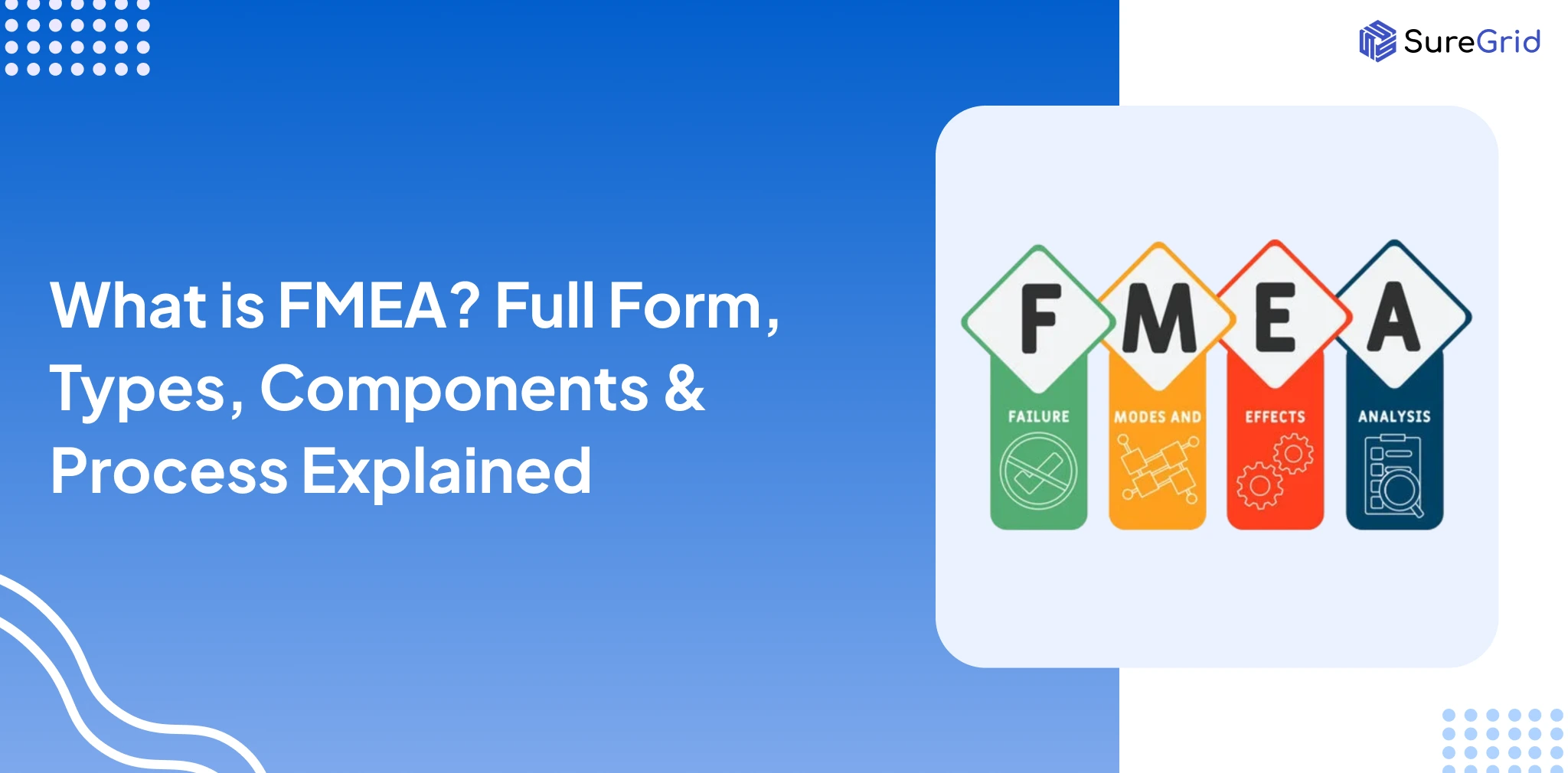
What is FMEA’s full Form?
FMEA’s full form is Failure Mode and Effects Analysis. It is a systematic methodology used to identify and evaluate potential failure modes within a system, process or service before it can occur. The main objective of FMEA is to identify and prioritize potential failures, determine their causes and effects, and develop strategies to prevent or eliminate them before they happen.
FMEA in quality management helps businesses improve product reliability, process efficiency, and customer satisfaction by identifying risks early.
Simplify Your Compliance & Stay Audit-Ready
Help your team manage controls, risks, and audits with ease
What is the value of FMEA?
Different industries use different types of FMEA analysis depending on whether they are evaluating products, manufacturing processes, systems, software, or services.
- Prevent Problems before they can Occur: It detects possible issues during the design or planning phase. This allows companies to adopt corrective actions before any problems occur.
- Enhance Product Quality: It studies potential failures and defects, which allows businesses to enhance the quality and efficiency of their products and services.
- Improve Customer Satisfaction: It reduces the chances of failure, leading to more satisfied customers, fewer complaints, and higher customer satisfaction with customers.
- Reduce Costs: It can help prevent costly repairs such as recalls, rework, and delays in production by preventing problems before they occur.
- Increase Safety: It pinpoints the causes of risks to the safety of employees, users, or equipment, and assists in reducing the risks.
- Make better decisions: This offers an organized way to prioritize risks according to severity, occurrence, and the possibility of detection. This assists management in focusing on the most important concerns.
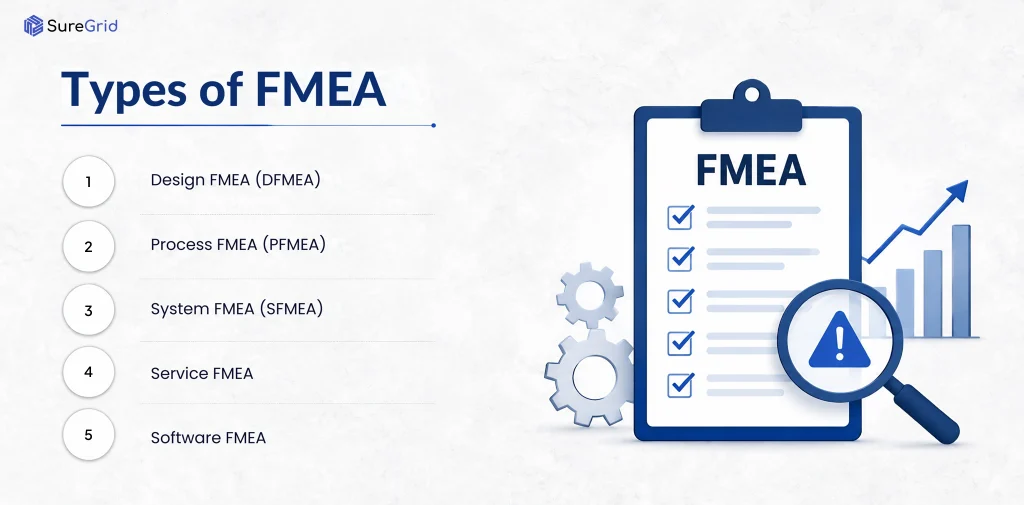
Types of FMEA
Various types of FMEA are used based on the subject being studied:
- Design FMEA (DFMEA): It is focused on the possibility of issues with product design. It helps engineers identify weaknesses in their designs before they begin production. This is a common practice in the electronics, automotive, and aerospace sectors.
A common FMEA example in automotive manufacturing is identifying brake system failures before vehicle production begins.
- Process FMEA (PFMEA): It analyzes the causes of failures that could occur during assembly or manufacturing processes. It assists in reducing production defects caused by equipment malfunction, operator errors, and processing variations.
An FMEA analysis example in manufacturing includes detecting machine calibration issues that may lead to defective products.
- System FMEA (SFMEA): It analyzes how various systems or subsystems interact with each other. It also identifies any risks that could impact the overall performance of the system.
- Service FMEA: It focuses on identifying the risks in the process of providing services and interactions with customers.
- Software FMEA: It identifies possible software-related malfunctions like crashes, bugs, or issues with compatibility of systems.
What are the key Components of FMEA?
The main elements in FMEA are:
- Failure Modes: A failure mode is how a product, procedure, or even a system may fail. It describes what can happen during operations or use.
- Failure Effect: It describes the consequences or effects of the failure on the operations, customers, and safety, as well as the quality of the product.
- Failure Cause: It determines the root cause that led to the failure. Understanding the root causes helps companies avoid similar problems from occurring in the near future.
- Current Controls: These are the techniques of checks, procedures, or methods employed to prevent malfunctions or identify the signs of failure before they can cause serious issues.
- Severity (S): It determines how severe the impact of a malfunction could be if it happens. It’s usually scored on a scale from 1 to 10.
- Low Score = Minor Impact
- A high score means critical or potentially dangerous impact
- Occurrence (O): Occurrence is a measure of how often the possibility of failure will occur. It also ranks by a scale of 1-10.
- Low Score = Rare Failure
- High Score = Frequent Failure
- Detection: It evaluates the capability of the current control system to detect the problem before it gets to the customer or creates harm.
- Low Score = Easy to detect
- Achieving a high score means failure difficult to identify
(Note: For Severity, Occurrence, and Detection, a higher score always indicates higher risk)
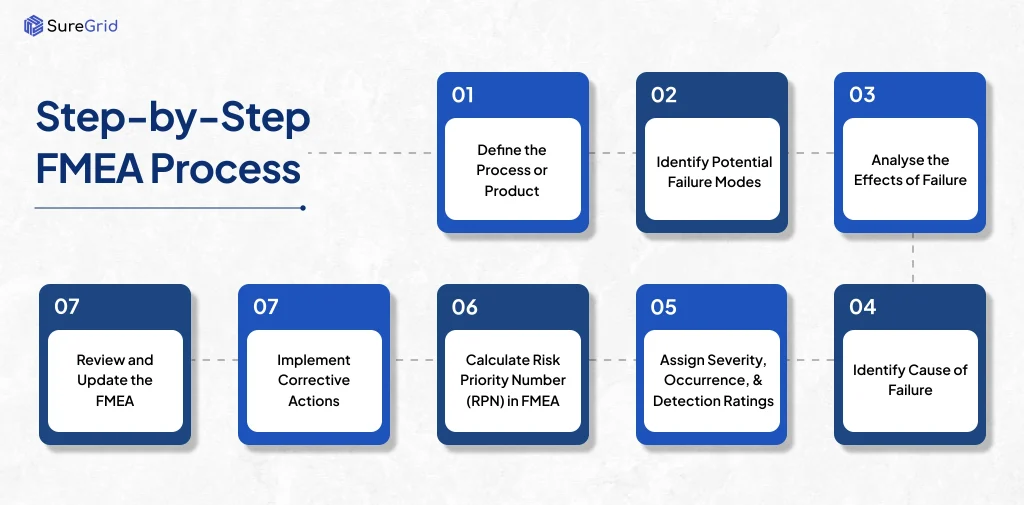
Step-by-Step FMEA Process
It follows a prescribed procedure to determine the possibility of failure and its potential impact and to minimize the risk of failure:
Step 1: Define the Process or Product: First, define the system, product, or process that is being studied. Companies should establish the scope, goals, and boundaries for an FMEA study.
Step 2: Identify Potential Failure Modes: An organization must list every possible way that the process or product could fail. The failures could affect the quality, safety performance, or even customer satisfaction.
Step 3: Analyse the Effects of Failure: It examines the consequences of failure mode and how it impacts the operations of customers, their customers and the business’s performance.
Step 4: Identify Cause of Failure: It identifies the root of each issue. The ability to determine the cause is helpful in helping organizations take preventative measures.
Step 5: Assign Severity, Occurrence, and Detection Ratings: Each failure is graded in accordance with three criteria:
- Severity (S): How severe the failure is
- Occurrence (O): How often the failure occurs
- Detection (D): How easily the failure can be detected before it reaches the customer
Step 6: Calculate Risk Priority Number (RPN) in FMEA: This number is a tool to help companies identify the failures that require immediate attention. It can be calculated by multiplying the Severity, Occurrence, and Detection scores.
RPN = Severity x Occurrence x Detection
Step 7: Implement Corrective Actions: If you have identified high-risk failures, the business must take steps to mitigate or eliminate the risk.
Step 8: Review and Update the FMEA: FMEA should be reviewed on a regular basis to ensure that it is accurate and efficient. Updates can help organizations handle new risks and improve the process constantly.
Conclusion
FMEA (Failure Mode and Effects Analysis) assists businesses in identifying issues before they turn into serious issues. It analyzes the causes of failure and the effects they have. Companies can improve the quality of their products, improve operational efficiency, lower costs, and increase satisfaction of customers. It helps in making better decisions and prioritizes risk based on severity, occurrence, as well as detectability ratings.
FAQs
Ques: What are the 5 Steps of the FMEA Process?
Ans: The 5 steps are defining the process, identifying possible failures, analyzing their effects and causes, prioritizing risks, and taking corrective actions.
Ques: What is the difference between FMEA and FMECA?
Ans: FMEA focuses on identifying risks and causes, whereas FMECA ranks failures based on their criticality or severity.
Ques: What is FMEA Analysis?
Ans: FMEA analysis is a structured method used to identify, analyze, and prevent possible failures in a product, process, or system before they occur.
Ques: What is the importance of FMEA for a business?
Ans: It helps businesses reduce risks, enhance quality, lower costs, and prevent failures.
Ques: What are the FMEA Principles?
Ans: The FMEA principles are identifying failures, understanding the effects and causes, evaluating risks, and enhancing the process continuously.
Ques: What is FMEA in Quality?
Ans: It is used to identify process or product risks, improve quality standards, and reduce defects.
Simplify Your Compliance & Stay Audit-Ready
Help your team manage controls, risks, and audits with ease