
Organizations are often asked about the SOC 1 and SOC 2 certificates before initiating a business with the company. Businesses get confused between SOC 1 vs SOC 2 certificates, and which one they should have. The following blog helps you know the difference between the two terms and choose the correct one.
What is SOC?
SOC is a system of audit reports that evaluates the effectiveness of an organization’s internal controls for data security and financial reporting. These reports aid clients, partners, and others in assessing the effectiveness of an organization’s internal controls. It helps ensure that the business has in place controls for security as well as availability and integrity of financial transactions.
What is SOC 1?
A SOC 1 report comes under the SSAE (Statement on Standards for Attestation Engagements) 18 AT-C 320. It ensures that service organizations’ internal controls are designed and operating effectively. It protects financial data that impacts users’ financial reporting.
It gives transparency to the clients and auditors about the security and integrity of financial processes. Payroll processors, SaaS vendors handling billing, loan services, and data centers need these controls.
SOC 1 Type I
SOC 1 Type 1 helps check a company’s internal controls at a specific point in time. It checks whether the controls related to financial reporting are properly designed and implemented.
This report is better for organizations that want to demonstrate that they have the right systems and processes in place. It does not verify how effective those controls are over time,
SOC 1 Type II
SOC 1 Type II provides a detailed and reliable assessment. It evaluates the internal control over a defined period (usually 3 to 12 months). It checks controls and operating effectiveness over time. This report assures clients and auditors that controls are consistently working. Because it proves that the controls are consistently working.
Simplify Your Compliance & Stay Audit-Ready
Help your team manage controls, risks, and audits with ease
What is SOC 2?
SOC 2 is an independent third-party audit report. This report contains the details of how a service organization protects customers based on the AICPA Trust Services Criteria (Security, Availability, Processing Integrity, Confidentiality, Privacy).
It verifies whether the controls are designed appropriately (Type 1) and operating over time (Type 2). B2B vendors use these reports to confirm security posture and make the procurement process efficient.
SOC 2 Type I
It evaluates the design of a company’s controls at a specific point in time. It examines whether the necessary security and compliance controls are implemented according to the Trust Services Criteria. It is useful for organizations that are in the early stages of compliance.
SOC 2 Type II
SOC 2 is an audit report that verifies that data security and internal controls are properly followed in a certain period of time, between 3 months and 12 months. An independent auditor audits and checks the processes, controls, monitoring systems, and security practices.
What is the Difference between SOC 1 vs SOC 2?
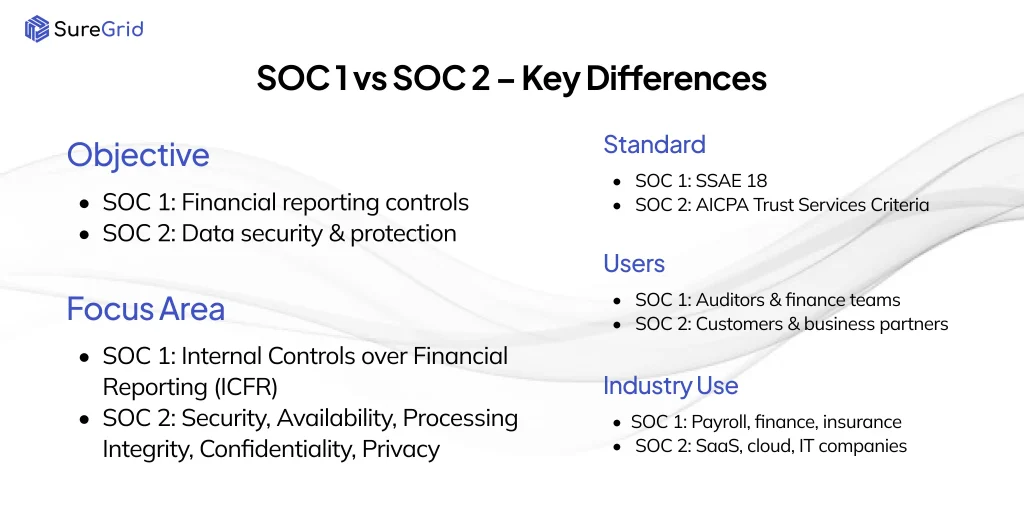
| Basis | SOC 1 | SOC 2 |
| Primary Objective | Evaluates controls related to financial reporting | Evaluates controls related to data security and protection |
| Focus Area | Internal Controls over Financial Reporting (ICFR) | Trust Service Criteria (Security, Availability, Processing Integrity, Confidentiality, Privacy) |
| Applicable Standard | Based on SSAE 18 (financial reporting controls) | Based on AICPA |
| Users | Auditors, finance teams, and stakeholders involved in financial reporting | Customer, partners, and stakeholders are concerned about data security |
| Industry Usage | Financial service providers, payroll processors, and insurance companies | SaaS companies, cloud service providers, IT and Technology firms |
| Type and Data Covered | Financial data impacting client financial statements | Customer data, personal data, and system data |
| Purpose | Ensures accuracy and reliability of financial transactions | Ensure secure handling and protection of sensitive information |
| Regulatory Relevance | Supports financial audits and compliance requirements | Helps meet data protection and security expectations |
| Report Distribution | Restricted to management auditors, and regulators | Can be shared with customers under NDA |
| Risk Addressed | Financial misstatements, fraud in financial processes | Data breaches, unauthorized access, and system vulnerabilities |
| Example use cases | A payroll company processing employee salaries for clients | A SaaS platform storing and processing customer data |
| Audit Scope | Limited to controls affecting financial reporting | Broad scope covering IT systems, process, and security practices |
What should a business choose, SOC 1 vs SOC 2?
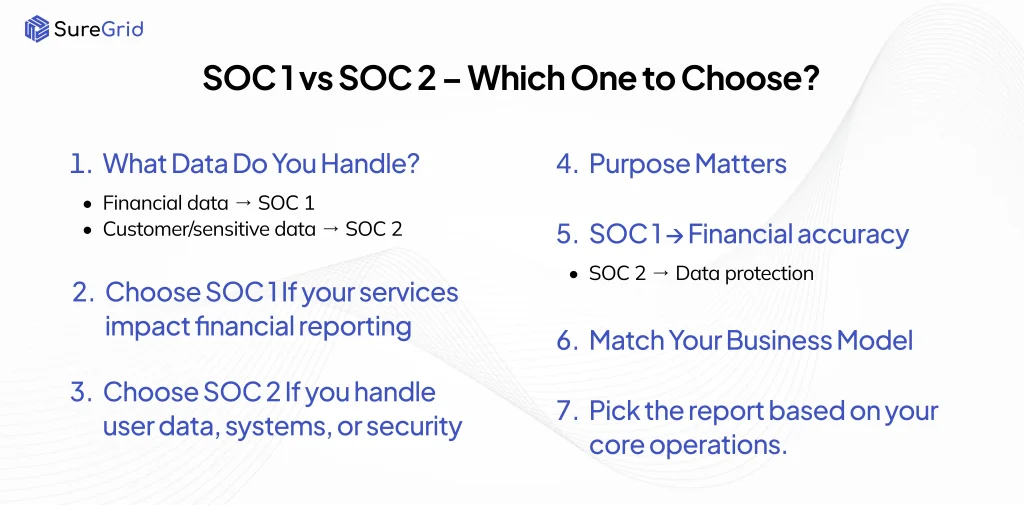
Choosing between SOC 1 and SOC 2 totally depends on your business needs. For example, if you deal with financial information, you should choose SOC 1. If you are dealing with sensitive information, however the data is not related to finances, you should choose SOC 2. Both of the controls come under the SOC controls used within your organization. The framework differs in focus.
Conclusion
SOC 1 focuses on the internal controls of an organization handling financial reporting. In contrast, the SOC 2 report focuses on the organization’s control over handling sensitive information, not financial information. Selecting the best one depends on the type of operations and the data the business has to handle.
FAQs
Ques: What does SOC 1 stand for?
Ans: SOC 1 stands for System and Organization Controls 1.
Ques: What is SOC 1 vs 2 vs 3?
Ans:
- SOC 1: It covers internal controls over financial reporting (ICFR).
- SOC 2: It covers security, availability, processing integrity, and privacy (Trust Service Criteria)
- SOC 3: It is a public-facing, simplified version of a SOC 2 report.
Ques: How much do SOC 1 and SOC 2 cost?
Ans: SOC 1 and SOC 2 audits typically cost between $20,000 and $150,000.
Ques: How long does it take to get a SOC 1 or SOC 2 report?
Ans: Type I → Point in time
Type II → 3–12 months
Ques: Is SOC 2 Mandatory in India?
Ans: No, it’s not mandatory, but clients often require it…” The missing “not” changes the meaning completely.
Ques: Which companies need SOC 2?
Ans: Companies that store, process, or transmit customer data, such as:
- SaaS Companies
- Cloud Service Providers
- IT and tech firms
Simplify Your Compliance & Stay Audit-Ready
Help your team manage controls, risks, and audits with ease