

AI is everywhere now. Your team may already be using it to write emails, reply to customers, or check documents. That is useful. But it also brings risk. If nobody is watching, AI can leak private data, treat people unfairly, or make a wrong call that costs you money.
AI governance is how you stay in control of all this. Here in this blog, you will learn about AI Governance in India, What it means, what the new India rules say, and how to start.
Key Takeaways
- AI governance is control. It means knowing what AI your company uses, who owns it, and whether you follow the law.
- India has no separate AI law yet. It uses laws we already have, like the DPDP Act and the IT Act, and fixes the gaps.
- Two rulebooks matter most. The India AI Governance Guidelines (November 2025) apply to everyone. Banks and NBFCs also follow the RBI FREE-AI framework (August 2025).
- Consent is not optional. Under DPDP Compliance, you need permission before you use personal data in AI. Fines go up to Rs 250 crore.
- You can start small. List every AI tool, mark the risky ones, give each an owner, and keep a human in charge of the big calls.
What is AI Governance?
AI governance is the process of making sure artificial intelligence is developed and used responsibly. It involves setting rules, policies, and controls to ensure AI systems are safe, fair, transparent, secure, and compliant with laws. Good AI governance helps organizations reduce risks, protect user data, and build trust.
Why is AI Governance Important in India?
A few years back, only a few people used AI at work. Today it sits inside hiring, customer support, loan checks, and the software you already pay for.
So, the risk is real and continues to grow. Two things changed in 2025. The government wrote its first proper set of AI rules. And the RBI told banks and lenders to manage AI risk directly. Your customers have noticed too. Many customers now ask you to prove your AI is safe before they sign a deal. A policy on paper is not enough anymore.
What Do India’s New AI Rules Say?
In November 2025, the government, through MeitY, released the India AI Governance Guidelines. Here is the short version. India will not bring a separate AI law for now. Instead, it will use the laws we already have and fix the gaps.
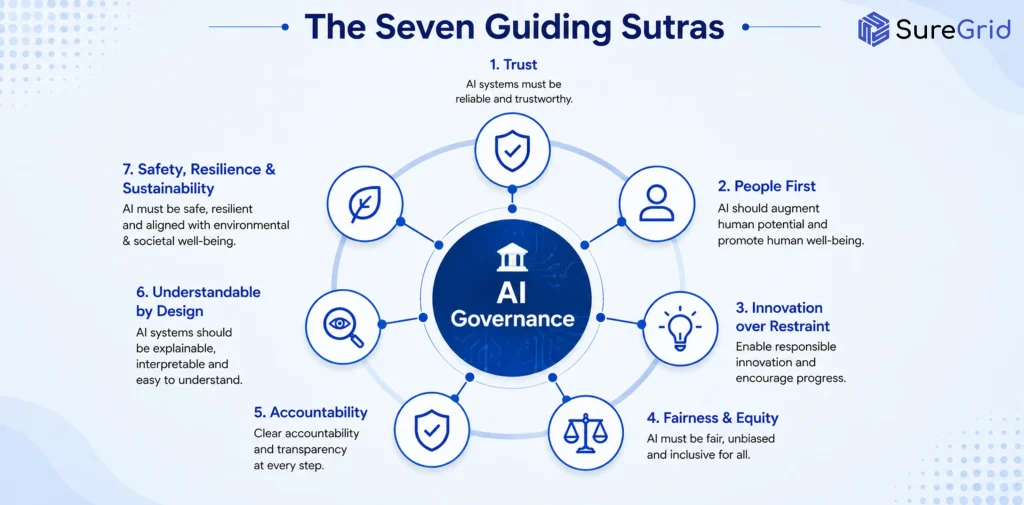
The seven guiding sutras are:
- Trust: Trust is the basic foundation that builders, regulators and users should maintain which helps in AI adoption and progress in India.
- People First: AI governance should be people-centred. It must be under the human control, oversight and ethical safeguards, safety, and capacity, and follow social values.
- Innovation over Restraint: It should promote responsible AI innovation and adoption to increase socio-economic development and global competitiveness that maximise benefits and minimise harm.
- Fairness & Equity: AI governance should promote inclusive and fair AI, prevent bias and discrimination against marginalised communities. It must reduce exclusion and unequal outcomes.
- Accountability: AI developers should build safe, reliable, and efficient AI systems that detect risks early, reduce harm, save resources, and encourage smaller, eco-friendly models. It should be ensured via policies and market-led mechanisms.
- Understandable by Design: AI systems should prioritise understanding through clear explanations and disclosures. It help users and regulators understand how they work, their impact, and expected outcomes.
- Safety, Resilience & Sustainability: AI systems should reduce harm through strong safeguards, resilience, anomaly detection, and early warnings. They should promote environmentally responsible, resource-efficient, and lightweight models.
To manage all this, the government is setting up a few new groups. One to guide AI policy, one to advise on the tech, and one to test AI systems for safety.
In August 2025, the RBI released a framework called FREE-AI. It gives lenders 26 recommendations. Things like getting board approval for AI use, keeping a list of every AI tool, and reporting problems.
| Item | Date or Number |
| India AI rules released | November 2025 |
| RBI FREE-AI released | August 2025 |
| DPDP Rules notified | November 2025 |
| DPDP deadline | May 2027 |
| Highest DPDP penalty | Rs 250 crore |
| Steps in RBI FREE-AI | 26 |
Which Laws Already Apply to AI?
Even without a separate AI law, these Indian laws already apply the moment you use AI.
The DPDP Act (data privacy law): If you use people’s personal data to train or run AI, you need their permission first. The rules came out in November 2025. Full compliance is expected by May 2027, and fines can go up to Rs 250 crore.
The IT Act, 2000: Covers data safety and misuse of digital tools, including AI.
The Bharatiya Nyaya Sanhita, 2023 (the new criminal law): Covers harmful AI use, like deepfakes and fake identities.
The Consumer Protection Act, 2019: Applies if your AI misleads a customer. For example, a chatbot that makes promises it cannot fulfill.
Your industry rules: Banks and lenders also follow the RBI FREE-AI framework. Other regulators, like SEBI, cover their own areas.
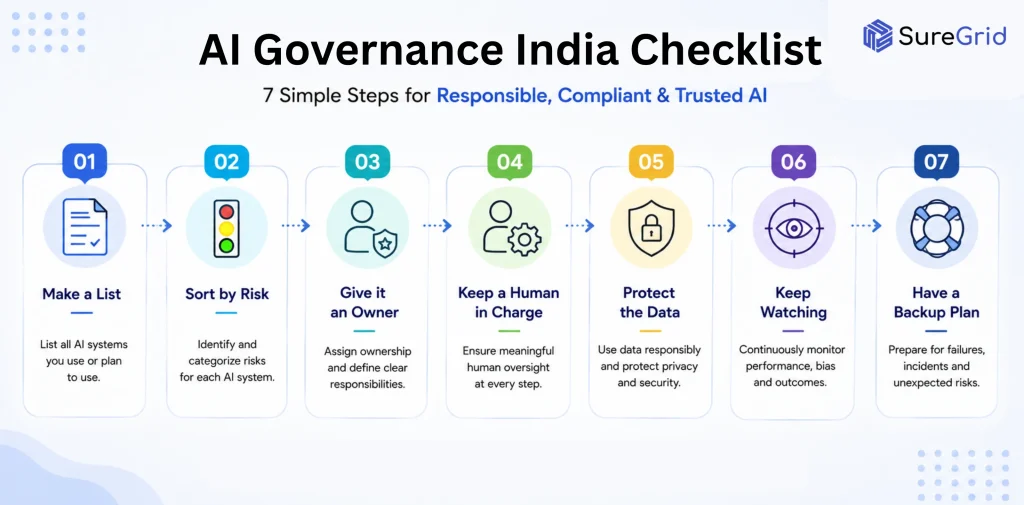
What Does a Good AI Governance India Checklist Include?
You need to follow this AI Governance checklist to avoid issues:
Make a list: Write down every AI tool your company uses, including the ones people started on their own. You cannot control what you cannot see.
Sort by risk: Some AI is low risk, like a tool that shortens notes. Some is high risk, like AI that approves loans or picks job candidates. Spend your time on the high-risk ones.
Give it an owner: Each AI tool needs one person who is responsible if it goes wrong.
Keep a human in charge: For big decisions, a person should have the final say. Do not leave it fully to the machine.
Protect the data: Know what personal data each AI uses, where it is stored, and whether you have permission. This is where privacy and AI meet.
Keep watching: Monitor, sometimes it slowly starts giving wrong answers, and you want to detect that early.
Have a backup plan: Know what to do if the AI leaks data, gives a biased result, or does something it should not.
Most AI problems start with data. If you do not know what personal data your AI uses, where it sits, or whether you have consent, nothing else is safe. A compliance management platform like SureGrid helps you find that data, manage consent, and stay ready for any data breach.
FAQs
Ques: What is AI governance in simple words?
Ans: AI governance is how a company keeps control of the AI it uses. It means knowing which AI tools you have, deciding who is responsible for them, keeping a human in charge of big decisions, and making sure you follow the law.
Ques: Does India have an AI law?
Ans: No, India has not made a separate AI law yet. In November 2025, MeitY released the India AI Governance Guidelines. These use the laws we already have, like the DPDP Act and the IT Act, and fix the gaps instead of adding a whole new law.
Ques: How does the DPDP Act affect AI?
Ans: The DPDP Act is India’s data privacy law. If your AI uses people’s personal data, you need their permission first. Breaking the rules can lead to fines of up to Rs 250 crore, with full compliance expected by May 2027.
Ques: What is the RBI FREE-AI framework?
Ans: FREE-AI is the RBI’s rulebook for AI in banking and lending. It came out in August 2025 and gives 26 clear steps, such as board approval for AI use, keeping a list of AI tools, and reporting problems.
Ques: How do I start with AI governance?
Ans: Begin with making list of tools your company use. Mark which ones are high risk, give each a responsible owner, write a few simple rules, and keep checking the tools over time. Begin with the riskiest ones first.
Simplify Your Compliance & Stay Audit-Ready
Help your team manage controls, risks, and audits with ease