
Almost all business are rely on systems, data, and applications. And all of them are connected. They are prime targets for attackers to find vulnerabilities and attack. To prevent this, businesses need a proactive approach, not reactive after the attack occurs. The (Threat and Vulnerability Management) helps there. In this blog, you will learn about Threat and Vulnerability Management, its importance, differences, components, and more.
What is Threat and Vulnerability Management?
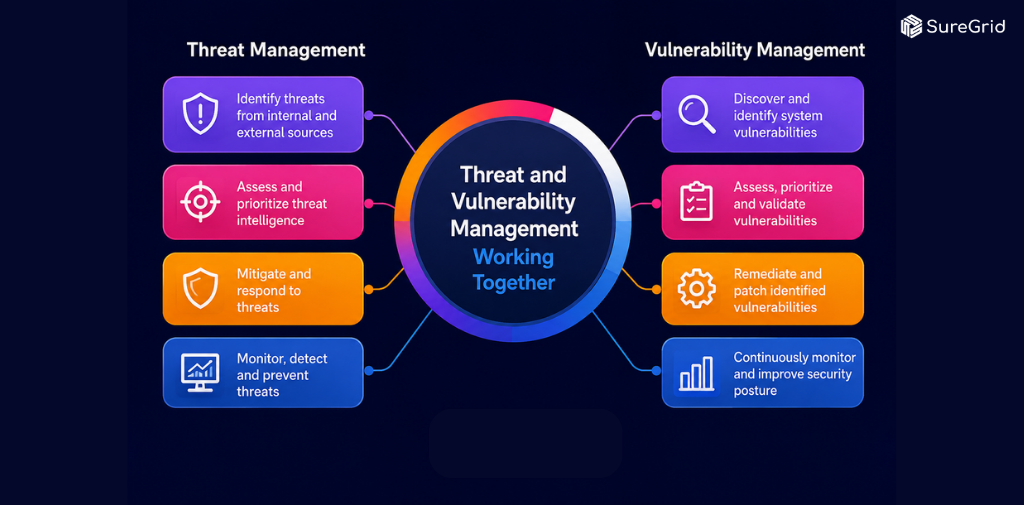
It’s a proactive cybersecurity procedure that assists businesses in identifying and addressing security concerns. It performs two crucial functions:
- Identifying Security weaknesses (vulnerabilities)
- Monitoring cyberattacks
This helps companies identify high-risk vulnerabilities and prioritize them. The main goal behind TVM is to lower the chance of cyberattacks. Therefore, you can maintain secure data, systems, as well as business processes.
Why is Threat and Vulnerability Management Important?
These are the main reasons businesses should implement TMV:
- Protect yourself from cyberattacks. It assists in identifying and fixing vulnerabilities before attackers have the chance to take advantage of them.
- Reduce the risk of financial losses caused by downtime, data breaches, and costs for recovery.
- Secures cloud environments and remote work environments where the attack surface can be hard to monitor
- It increases customer confidence because it demonstrates that the business system is protected
- Effectively prioritizes risks so that your security resources are utilized in areas that matter the most
- Keep your regulatory compliance in line with standards like, SOC 2, GDPR, HIPAA, ISO 27001 and PCI-DSS.
Threat vs Vulnerability: What is the difference
Here’s the primary difference between vulnerability and threat:
| Threat | Vulnerability |
| Potential cyber danger | Weakness the danger exploits. |
| Exploits vulnerabilities | Can be exploited by threats |
| Created by attackers or malware | Caused by bugs or misconfigurations |
| Dynamic and changing | Exists until fixed |
| Mitigated through detection and response | Fixed through patching and remediation |
| Examples: Phishing, ransomware, DDoS | Examples: Unpatched software, weak passwords, open ports |
Key Components of Threat and Vulnerability Management
A successful Threat and Vulnerability Management (TVM) program contains the following key elements:
- Asset Discovery – Discover every device, application, and system within your company.
- Threat Intelligence – Stay informed on the latest cyber threats and techniques for attack.
- Prioritize Risk – Address the most dangerous security vulnerabilities first based on the risk.
- Resolve security patches – Apply them, modify settings, or take other steps to resolve issues.
- Continuous Monitoring – Check your systems for any new vulnerabilities and suspicious activities.
- Incident Response Plan – Make plans to respond quickly to cyberattacks and recover from them.
- Security Awareness – Teach employees how to spot and avoid the most common cybersecurity threats.
Simplify Your Compliance & Stay Audit-Ready
Help your team manage controls, risks, and audits with ease
What Is a Threat and Vulnerability Assessment?
The Threat and Vulnerability Assessment (TVA) is an audit of security that helps organizations identify security holes in their systems.
- Examines potential cyber threats and security flaws.
- Examines how vulnerabilities can be exploited.
- Determines the risk and impact on business.
- Prioritizes vulnerabilities on the basis of their degree of severity.
- Recommends remediation measures to lessen security dangers.
- It provides a benchmark to help improve the security measures.
How Does Threat and Vulnerability Management Work?
Security and Threat Vulnerability Management (TVM) can be described as an ongoing process that assists companies identify, correct and monitor security threats.
- Identify Threats and Vulnerabilities – Scan systems to find security weaknesses and possible threats.
- Analyze Risks – Check how each vulnerability could be exploited and how it may affect the business.
- Prioritize Issues – Fix the most critical vulnerabilities first based on risk and business impact.
- Remediate or Mitigate – Apply patches, update settings, or use security controls to reduce the risk.
- Verify the Fix – Re-scan systems to confirm the vulnerabilities have been resolved.
- Document and Report – Record the findings, actions taken, and remaining risks for future tracking and compliance.
What is Risk-Based Threat and Vulnerability Management?
The Risk-Based Security and Vulnerability Management concentrates on business-related impact, not solving issues equally. It evaluates assets in terms of the vulnerability of an asset, its exploitability, and risk scores, such as CVSS. In the end, security teams concentrate on weaknesses that pose the greatest risks to business and make use of resources more efficiently.
Important aspects
- Asset value
- CVSS Score
- Threat Intelligence
- Exploit Availability
- Impact on business
Who Is Responsible for Threat and Vulnerability Management?
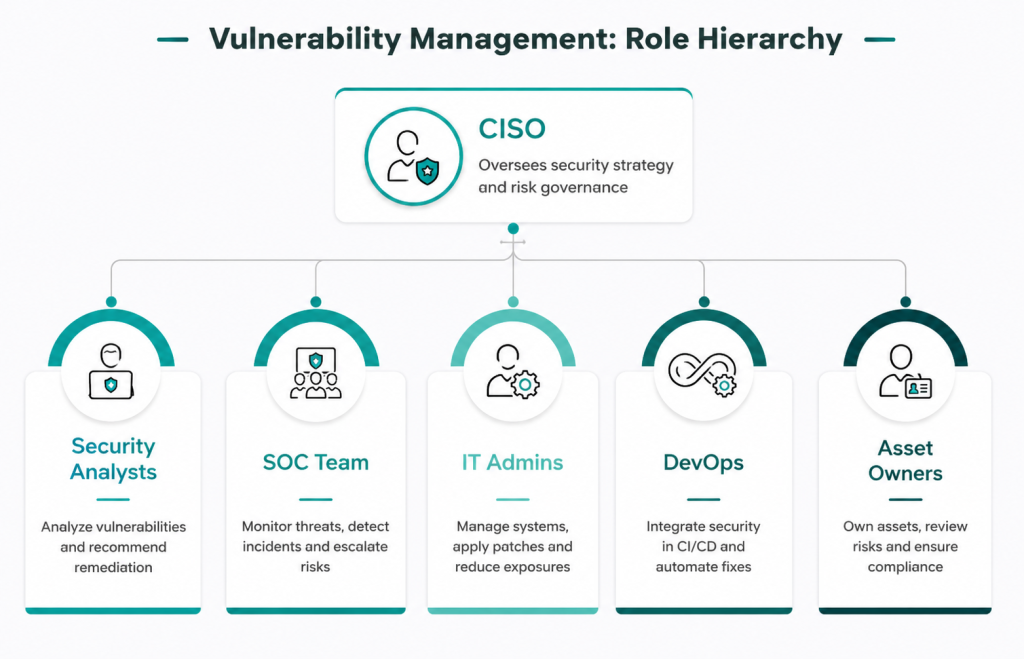
It is overseen by a variety of team members, including the IT team, security and business stakeholders.
| Role | Responsibility |
| CISO | Strategy for security and Governance |
| Security Analysts | Monitoring and assessment of risk |
| SOC Team | Response to threats and detection |
| IT Administrators | Patch management |
| DevOps Teams | Secure application deployment |
| Asset Owners | Validate and approve the remediation |
What are the most pressing issues in managing vulnerability and threat?
Companies often face these challenges:
- A large number of security vulnerabilities to manage and identify.
- Security resources are limited to investigate and correct.
- False positives that consume time and energy.
- Insufficient visibility of assets across endpoints, cloud and networks.
- Patch management is slow due to operational limitations.
- It is difficult to prioritize risks based on the actual business impact.
- Systems from the past that aren’t easily patched.
- The absence of continuous monitoring for new weaknesses.
Best Practices for Threat and Vulnerability Management
Use these best methods to make your threat and vulnerability management (TVM) Program more efficient:
- Keep an inventory of all assets, devices, apps, and systems.
- Prioritize weaknesses based on severity, risk, and the impact on business.
- Regularly scan for vulnerabilities with manual or automated methods.
- Make use of AI as well as threat intelligence in order to identify threats more quickly and decrease false positives.
- Find and fix security configurations that aren’t working before they can be used to gain access.
- Establish clear security procedures for patching, scanning, and remediation.
- Implement strong access control to stop unauthorized access.
- Check your incident response plan regularly to ensure you are prepared for cyberattacks.
- Documentation is essential to help ensure security audits and compliance.
- Always monitor your systems for emerging vulnerabilities and threats.
How SureGrid Helps?
SureGrid is an AI compliance automation platforms that offer cloud security, security questionnaires, compliance management, and vulnerability assessment in one place. It constantly checks your system for vulnerabilities that are real and then analyzes the cloud environment to identify real security threats instead of generating unnecessary alerts. It automatically collects audit evidence for more than 60 compliance frameworks, such as ISO 27001, SOC 2, GDPR, HIPAA, as well as PCI DSS. With real-time cybersecurity risk and monitoring of risk from vendors, SureGrid helps you find prioritizing, address, and resolve crucial security problems faster, while being prepared for audits.
FAQs
Ques: What are the 5 steps of vulnerability management?
Ans: The five steps of vulnerability management are
- Discovery
- Assessment
- Prioritization
- Remediation
- Verification and Reporting
Ques: What is threat and vulnerability management?
Ans: It is a cybersecurity process that combines both vulnerability assessment and threat intelligence. This combination helps businesses find, fix, and prioritize security risk. This prevents the chance of cyber attacks.
Ques: What are the 4 types of threats?
Ans:
- Malicious threats – Deliberate attacks such as malware, ransomware, phishing, or insider abuse.
- Accidental threats – Unintentional actions like misconfigurations, lost devices, or weak permissions.
- Environmental threats – Power failures, natural disasters, or infrastructure outages that disrupt systems.
- Structural threats – Systemic weaknesses like legacy architecture, poor network segmentation, or weak governance that compound risk over time.
Ques: What are the 4 types of vulnerabilities?
Ans:
- Network vulnerabilities – Open ports, weak firewall rules, or unsecured connections.
- Software/application vulnerabilities – Coding bugs, unpatched software, and outdated dependencies, including known CVEs and zero-days.
- Hardware and configuration vulnerabilities – Misconfigured systems, default settings, or outdated and unsupported devices.
- Human and procedural vulnerabilities – Weak passwords, poor security awareness, and flawed processes — the most exploited weakness of all.
Simplify Your Compliance & Stay Audit-Ready
Help your team manage controls, risks, and audits with ease